
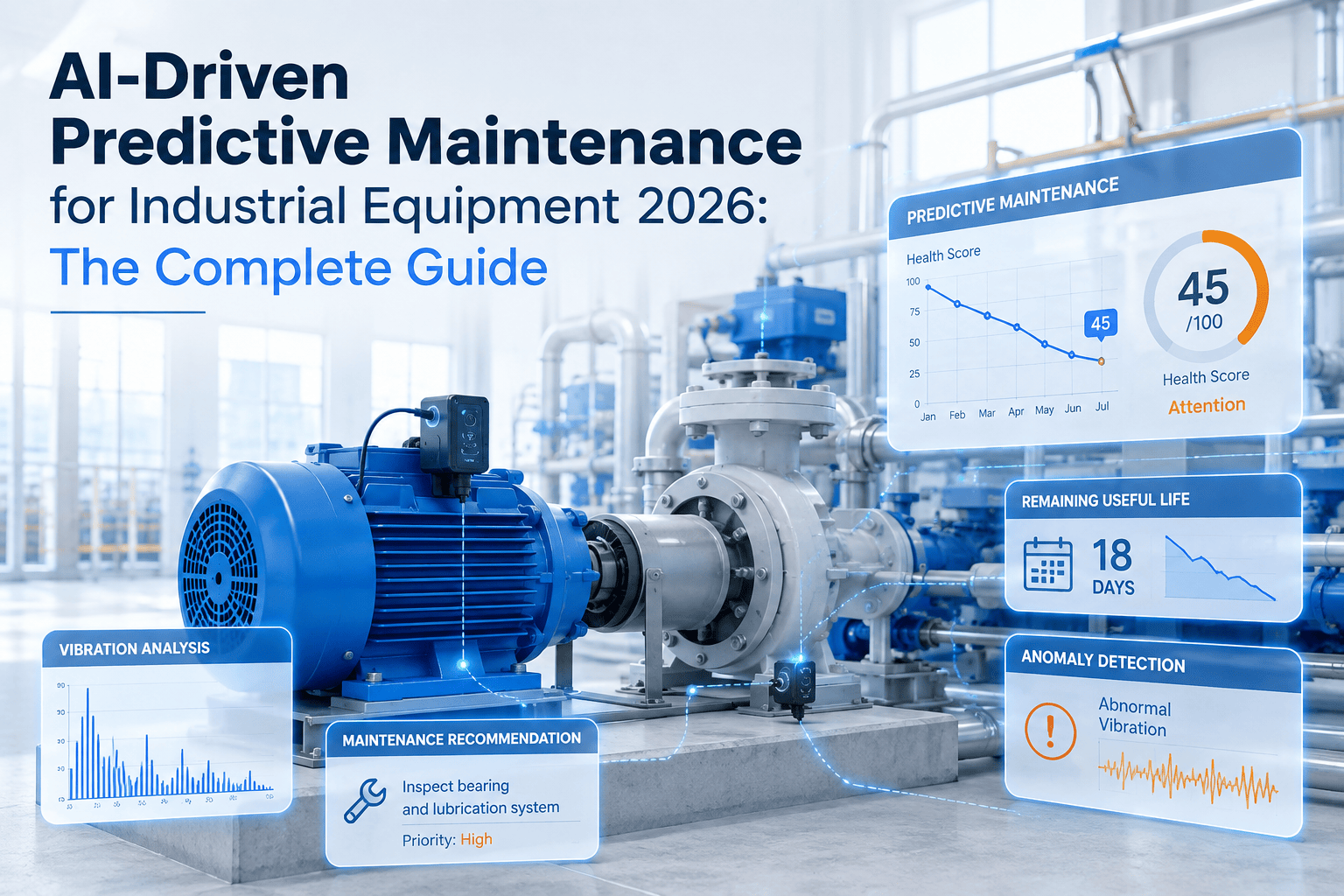
Most industrial plants still treat maintenance as something that happens on a calendar a fixed interval that arrives whether a machine needs attention or not. In 2026, that model is being replaced. AI-driven predictive maintenance uses live sensor data, machine learning models, and anomaly detection to tell maintenance teams exactly when and why a machine will fail, hours or days before it does. Through our Industrial AI Solutions and Smart Factory & Industry 4.0 capabilities, Palladium Dynamics helps manufacturers across Pune, Chakan, Ranjangaon, Pimpri-Chinchwad, Hinjewadi, Bhosari, and Talawade turn this shift from reactive to predictive into measurable uptime and cost gains.
Quick Answer
AI predictive maintenance uses machine learning, IIoT sensors, and anomaly detection algorithms to continuously monitor equipment health and predict failures before they happen. It replaces fixed-schedule preventive maintenance with condition-based interventions triggered only when data indicates an actual approaching failure, reducing unplanned downtime by 25–45%, maintenance costs by 20–40%, and extending equipment life by 15–30% in well-implemented deployments.
What Is AI Predictive Maintenance and Why It Matters in 2026
Predictive maintenance AI is the practice of feeding continuous sensor readings, vibration signatures, thermal images, current draw, acoustic data, and process variables into machine learning models that have been trained to recognise the early signatures of specific failure modes. When the live data begins to drift toward those patterns, the system alerts maintenance engineers with enough lead time to plan an intervention before a breakdown occurs.
What makes 2026 different from previous years is the convergence of three factors that previously held AI predictive maintenance back from widespread industrial adoption: affordable IIoT sensor hardware, mature cloud and edge computing infrastructure, and the arrival of generative AI that can interpret anomaly alerts in plain language and generate maintenance recommendations without requiring a data science team to read model outputs.
For plant managers and maintenance engineers across Maharashtra's manufacturing corridor, the shift from calendar-based preventive maintenance to AI-enhanced predictive maintenance for manufacturing systems is no longer a pilot-project conversation it is a competitive baseline for any facility running continuous or high-utilisation production.
Predictive vs Preventive Maintenance: The Core Difference
To understand the value of predictive maintenance AI, it helps to be precise about what it replaces. Preventive maintenance follows fixed schedules: a gearbox gets oil changed every 500 hours, a motor gets inspected every quarter, a bearing gets replaced every six months. The schedule is designed around the worst-case failure interval so that, on average, most assets are maintained before they fail.
The problem with this model is that it treats every asset identically regardless of actual operating condition. A motor running light duty in controlled temperatures and one running at peak load in a dusty, humid environment will not wear at the same rate, but preventive maintenance maintains both on the same clock. The result is wasted maintenance labour on healthy equipment, unnecessary part replacements, and still the occasional unexpected failure that falls between scheduled visits.
| Dimension | Preventive Maintenance | AI Predictive Maintenance |
|---|---|---|
| Trigger | Fixed time or usage interval | Condition-based, data-driven alert |
| Accuracy | Conservative; often over-maintains | Precise; intervenes only when needed |
| Data required | OEM service manuals | Live sensor data + historical failure patterns |
| Unplanned downtime risk | Moderate; some failures still occur between schedules | Low; failures predicted days to weeks ahead |
| Parts waste | High; parts replaced on schedule, not on condition | Low; parts ordered precisely when needed |
| Labour efficiency | Fixed roster regardless of actual need | Work orders generated only when data demands |
The shift from predictive vs preventive maintenance is not about abandoning schedules entirely it is about letting data replace the calendar as the primary trigger for maintenance action, reserving fixed-interval work only for tasks where sensor data cannot reliably substitute (lubricant quality tests, safety inspections, regulatory compliance checks).
How AI and Machine Learning Predictive Maintenance Works
A working machine learning predictive maintenance system has four layers, each of which must function reliably for the whole to deliver value:
1. Sensor & IIoT Data Collection
Vibration sensors, thermocouples, current transformers, acoustic emission sensors, and process historians stream continuous readings from monitored assets. For AI powered predictive maintenance for industrial IoT systems, edge gateways pre-process and compress data before transmission, reducing bandwidth requirements without losing failure-relevant signal fidelity.
2. Machine Learning Model Training
Historical sensor data, labelled with known failure events, trains supervised ML models to recognise failure signatures. Where historical failure data is sparse, unsupervised anomaly detection models learn the normal operating envelope and flag deviations statistically, without needing labelled failure examples.
3. Anomaly Detection & RUL Prediction
Live sensor streams are scored against trained models continuously. Anomaly detection flags when current readings deviate significantly from learned healthy baselines. Remaining Useful Life (RUL) models estimate how many hours or cycles remain before failure, allowing maintenance planners to slot interventions into planned downtime windows.
4. Alert Routing & Work Order Generation
Alerts are prioritised by severity and routed to maintenance engineers via CMMS integration, SCADA dashboards, or mobile notifications. Recommended corrective actions, parts lists, and estimated time-to-failure accompany each alert so engineers arrive with the right tools and components rather than diagnose from scratch.
Anomaly Detection and Remaining Useful Life: The Two Core AI Techniques
Two machine learning techniques do the heaviest lifting in any AI-driven predictive maintenance deployment, and understanding the difference between them helps maintenance teams set realistic expectations for what the system will and will not catch.
Anomaly detection trains on data from the asset operating normally and continuously compares live readings against this learned baseline. Any statistically significant deviation, such as a vibration frequency component appearing above its normal amplitude, a temperature rising 8°C above its usual operating band, or a motor drawing 12% more current for a given load, triggers an alert. Anomaly detection is particularly powerful for assets with complex, interdependent signals where simple threshold alarms miss subtle early-stage degradation. It is also the technique of choice for new assets with no historical failure data, since it requires no labelled failure examples to train.
Remaining Useful Life (RUL) prediction goes one step further. Rather than simply flagging that something is wrong, RUL models estimate how much operational time remains before a failure will occur, expressed as a specific number of hours, cycles, or days at current operating conditions. This transforms predictive maintenance from a reactive alert system into a proactive planning tool: maintenance managers can see that a bearing has an estimated 72-hour RUL and schedule replacement during the next planned production break, rather than waiting for an imminent-failure alarm.
Generative AI in Predictive Maintenance: What Changes in 2026
Generative AI predictive maintenance is the most significant development in the field for 2026. Traditional ML-based maintenance systems detect anomalies and output severity scores and sensor readings, but they leave the interpretation and work-order creation to maintenance engineers who must translate raw model outputs into actionable maintenance tasks.
Generative AI closes that gap in three ways. First, it synthesises failure scenarios for rare failure modes where limited historical data prevents training a reliable supervised model the generative model creates synthetic failure datasets that augment real data, improving model accuracy for low-frequency but high-consequence failures. Second, it generates natural-language maintenance summaries that describe what the anomaly detection system found, why it is significant, and what corrective action is recommended, reducing the cognitive load on technicians who previously needed data-science literacy to interpret model outputs. Third, it enables conversational interfaces where engineers can ask questions like "which assets across the Chakan plant have RUL below 48 hours this week?" and receive consolidated, prioritised answers without navigating a dashboard.
For AI driven predictive maintenance for smart manufacturing and Industry 4.0 environments, generative AI also integrates with digital twin models, allowing maintenance simulations to be run against a virtual replica of the asset before any physical intervention is planned.
AI Predictive Maintenance Use Cases Across Industries
The use cases for AI predictive maintenance span virtually every capital-intensive industry, but the specific failure modes, sensor types, and economic drivers differ significantly between sectors:
Manufacturing & Metal Industries
AI based predictive maintenance for industrial machines in stamping presses, CNC machining centres, injection moulding machines, and welding robots focuses on spindle bearing health, servo motor degradation, hydraulic pressure drift, and tool wear prediction. For Pune-Chakan-PCMC metal fabrication plants running two or three shifts, a single unexpected press breakdown during a production run costs far more in lost output and expedited changeover than a full predictive maintenance deployment.
Railways
AI ML applications in predictive maintenance for railways cover wheel and axle bearing degradation, pantograph wear, traction motor health, track geometry monitoring, and brake system condition across rolling stock fleets. Railway operators use RUL models to plan bogie overhauls during scheduled maintenance windows without pulling serviceable assets off the line prematurely, improving fleet availability at lower maintenance cost.
Energy Infrastructure
AI driven predictive maintenance for energy infrastructure spans wind turbine gearbox and blade monitoring, transformer thermal anomaly detection, substation switchgear health, and oil-and-gas pipeline corrosion assessment. Energy assets operate in remote or hazardous environments where manual inspection is costly and infrequent, making continuous AI monitoring the most practical path to reliability for operators across India's expanding renewable and grid infrastructure.
Aerospace Engines
AI driven predictive maintenance for aerospace engines monitors turbine blade temperature gradients, compressor stall precursors, oil system contamination, and vibration signatures from rotating components at extremely high resolution. In MRO (Maintenance, Repair & Overhaul) operations, ML models trained on fleet-wide flight cycle data predict component-level remaining life, allowing maintenance slots to be scheduled precisely rather than at conservative fixed-hour intervals.
Smart Manufacturing & Industry 4.0
AI driven predictive maintenance for smart manufacturing and Industry 4.0 environments integrates asset health data with digital twins, MES, and SCADA systems to create closed-loop maintenance automation. When a predictive model flags an impending failure, the system can automatically reduce line speed, shift production to a redundant cell, and generate a prioritised work order, all without human intervention, until the scheduled repair window arrives.
Industrial IoT Ecosystems
AI powered predictive maintenance for industrial IoT systems connects heterogeneous sensor networks, PLCs, and edge computing nodes into a unified asset health platform. The IIoT layer eliminates the data silos that previously made plant-wide predictive maintenance impractical, feeding a single ML pipeline that models can be trained and retrained on as more operational data accumulates over time.
AI Predictive Maintenance ROI: Making the Business Case
The AI predictive maintenance ROI question is the most common one plant managers ask before committing budget, and it has a more straightforward answer than most technology investments because the cost of the status quo is already known: the last unplanned breakdown's cost, the overtime maintenance bill, the customer penalty for a missed delivery, and the scrap produced during an emergency restart.
Where AI Predictive Maintenance ROI Comes From
Each hour of unplanned downtime on a high-volume press or packaging line typically costs ₹5–25 lakhs in lost output. Predictive maintenance eliminates the majority of these events by giving 24–72 hours of advance warning.
Calendar-based PM schedules generate maintenance work regardless of actual asset condition. AI predictive maintenance redirects those labour hours to assets that actually need attention.
RUL predictions let procurement order parts at the right time rather than holding months of buffer stock against unknown failure dates.
Early intervention prevents secondary damage (a worn bearing that runs to failure can damage the shaft, housing, and adjacent components). Catching failures early limits repair scope and preserves asset integrity.
For a typical mid-size manufacturer in Ranjangaon or Bhosari running 10–30 monitored assets, the combined ROI of avoiding two or three unplanned stoppages per year and eliminating unnecessary PM labour typically covers the full cost of a predictive maintenance deployment within 12–18 months of go-live. The specific numbers should be scoped against your plant's actual downtime history and maintenance spend rather than industry averages Palladium Dynamics can help structure that business case before any hardware is purchased.
Case Study: AI Predictive Maintenance at a Pune Automotive Components Manufacturer
Challenge: A Chakan-based automotive stamping manufacturer was experiencing three to four unplanned press breakdowns per month, primarily flywheel bearing failures and clutch-brake system degradation on high-tonnage presses running two full shifts. Manual inspection intervals were monthly and consistently missed early-stage bearing wear. Each unplanned stoppage cost approximately ₹8–12 lakhs in lost production and emergency maintenance mobilisation, and twice in the previous year had resulted in a premium freight charge to avoid line stoppages at their OEM customer.
Solution: Palladium Dynamics deployed vibration and temperature sensors on all 18 presses, connected through an IIoT edge gateway to a cloud-based AI predictive maintenance platform. Machine learning models were trained on 14 months of historical sensor data and tagged against maintenance records identifying known bearing and clutch failure events. Anomaly detection models provided a second layer of coverage for failure modes with insufficient historical examples. The platform integrated with the plant's existing CMMS, automatically generating work orders when anomaly scores exceeded defined thresholds, including RUL estimates and recommended replacement parts.
Results after 12 months:
- Unplanned breakdowns reduced from an average of 3.8/month to 0.4/month an 89% reduction
- Maintenance labour cost reduced by 28%, as PM visits were concentrated on assets flagged by the model rather than spread uniformly across all 18 presses
- Spare parts inventory value reduced by ₹18 lakhs due to just-in-time ordering based on RUL predictions
- Zero premium freight charges to OEM customers in the 12 months post-deployment, compared with two incidents in the prior year
- Full deployment cost recovered within 9 months based on downtime savings alone
What Plant Managers and Engineers Say About AI Predictive Maintenance
"We were sceptical that a machine learning model could catch bearing failures faster than our experienced team. Within three months, the system flagged a flywheel bearing degradation pattern our technicians had not detected during their last walk-around. We replaced it during the weekend stoppage and avoided what would have been a catastrophic mid-week failure. The ROI conversation was over after that first catch."
"The generative AI work-order feature was what surprised us most. Instead of a graph our maintenance engineers had to interpret, we get a plain summary: what the anomaly is, which component is likely affected, and what the recommended action is. It cut our mean time to respond to alerts by more than half because the technician arrives already knowing what to check."
"We use AI predictive maintenance now across two facilities in the Pune region. The SCADA integration was seamless the platform connected to our existing PLC network without any control system modifications. The dashboard shows us every asset's health score alongside production KPIs in a single view, which is exactly what our shift supervisors needed to make informed decisions."
Deploying AI Predictive Maintenance: A Practical Step-by-Step Approach
Most failed predictive maintenance deployments fail not because the AI technology doesn't work, but because the deployment scope was too ambitious at the start. The approach that consistently delivers early ROI and earns internal buy-in is a phased one, beginning with a tightly scoped pilot on the highest-criticality asset class:
| Phase | Activity | Typical Duration |
|---|---|---|
| 1. Asset Criticality Assessment | Rank assets by failure impact, failure frequency, and sensor instrumentation readiness. Select 3–8 high-criticality assets for pilot. | 1–2 weeks |
| 2. Sensor Instrumentation | Install vibration, temperature, current, and process sensors on pilot assets. Commission IIoT gateway and confirm data flow to platform. | 2–4 weeks |
| 3. Data Collection & Model Training | Collect baseline operational data (minimum 4–8 weeks for healthy-state baseline). Combine with historical maintenance records to train supervised and anomaly detection models. | 6–10 weeks |
| 4. Alert Validation & Tuning | Run model in parallel with existing maintenance practice. Validate alerts against actual asset condition, tune thresholds to reduce false positives without missing real degradation events. | 4–6 weeks |
| 5. CMMS & SCADA Integration | Connect predictive maintenance platform to CMMS for automated work-order generation and SCADA for process context overlay on anomaly events. | 2–4 weeks |
| 6. Plant-Wide Rollout | Extend sensor coverage and model training to remaining asset classes. Establish model retraining cadence as more operational data accumulates. | Phased, 3–9 months |
Why Palladium Dynamics for AI in Predictive Maintenance in India
As a leading AI in predictive maintenance company in India, Palladium Dynamics brings together the three capabilities that a successful deployment requires: deep industrial domain knowledge about the failure modes and operating environments of manufacturing, metal, and process industry equipment; proven IIoT sensor integration and PLC/SCADA connectivity experience; and AI and machine learning engineering capability to build, train, and maintain the models that make predictive maintenance accurate rather than simply alert-generating.
Our Industrial AI Solutions team deploys predictive maintenance across a range of asset types common in our service areas in Pune, Chakan, Ranjangaon, Pimpri-Chinchwad, Hinjewadi, Bhosari, Talawade, and broader Maharashtra and India from stamping presses and injection moulding machines to compressors, chillers, conveyor drive systems, and transformer banks. Our Smart Factory & Industry 4.0 practice integrates predictive maintenance data with digital twin models and MES systems for facilities building toward fully connected plant operations.
We scope every engagement starting from a business case built on your specific asset criticality and maintenance cost baseline, not a generic ROI template, so the pilot is sized to demonstrate value within your actual budget and decision timeline.
Integration with Existing Plant Systems
A common concern among plant managers considering their first AI predictive maintenance deployment is whether the platform will require ripping out and replacing existing SCADA, PLC, or CMMS infrastructure. In Palladium Dynamics deployments, it does not. Our sensor gateways and IIoT connectivity layer are designed to sit alongside existing control systems without disrupting them, reading data from PLCs, historians, and process instrumentation through standard OPC-UA, MQTT, or Modbus interfaces. The AI platform connects to your CMMS via API to push work orders directly into your existing maintenance workflow.
Scalable from Pilot to Multi-Site
For operators running more than one facility, Palladium Dynamics architects AI predictive maintenance platforms with multi-site consolidation from day one. A pilot on a single press line in Chakan can expand to cover the full Ranjangaon plant and eventually a third facility in Talawade, all on the same platform, with cross-facility anomaly benchmarking that identifies whether a degradation pattern observed in one plant is appearing elsewhere in the fleet.
Frequently Asked Questions About AI Predictive Maintenance
What is AI-driven predictive maintenance?
AI-driven predictive maintenance uses machine learning models, sensor data, and anomaly detection algorithms to continuously monitor industrial equipment condition and predict failures before they occur, allowing maintenance teams to act at precisely the right time rather than on fixed schedules or after a breakdown.
What is the difference between predictive and preventive maintenance?
Preventive maintenance follows fixed time or usage-based schedules regardless of actual equipment condition, often maintaining healthy assets unnecessarily. Predictive maintenance uses real-time sensor data and AI models to intervene only when condition indicators signal an approaching failure, reducing unnecessary stoppages and maintenance labour while preventing unplanned breakdowns.
What is Remaining Useful Life (RUL) in predictive maintenance?
Remaining Useful Life is a machine learning prediction that estimates how much operational time an asset or component has left before it will fail, based on current and historical sensor readings. RUL models allow maintenance planners to schedule interventions with precision, ordering parts and scheduling downtime windows before failure occurs.
How does anomaly detection work in AI predictive maintenance?
Anomaly detection trains models on historical normal-operation sensor patterns and continuously compares live readings against this baseline. Statistically significant deviations, such as a vibration spike or temperature drift outside learned bounds, trigger alerts so engineers can investigate before the deviation escalates into a failure.
What is the ROI of AI predictive maintenance?
AI predictive maintenance typically delivers ROI through three mechanisms: reducing unplanned downtime costs, extending asset life by avoiding run-to-failure damage, and optimising maintenance labour by eliminating unnecessary scheduled interventions. Industry benchmarks commonly cite 25–40% reduction in maintenance costs and 10–25% improvement in equipment availability, though actual results depend on asset criticality and baseline failure rates.
What role does generative AI play in predictive maintenance?
Generative AI in predictive maintenance augments traditional ML models by synthesising failure scenarios for which little historical data exists, generating maintenance work orders and root-cause summaries in natural language, and enabling conversational interfaces where engineers can query asset health without reading raw dashboards.
Which company in India provides AI predictive maintenance solutions?
Palladium Dynamics, based in Pune, Maharashtra, provides AI-driven predictive maintenance solutions for industrial machines and manufacturing systems across India, integrating IIoT sensor networks, machine learning models, SCADA connectivity, and real-time anomaly detection dashboards for clients in the Pune-Chakan-Ranjangaon-PCMC manufacturing corridor and beyond.
Ready to Move Your Plant from Reactive to Predictive?
Talk to Palladium Dynamics about deploying AI-driven predictive maintenance for your industrial equipment — from a single-asset pilot to a plant-wide IIoT and ML deployment.
Conclusion: From Calendar-Driven to AI-Driven Maintenance
The maintenance calendar was a reasonable tool when the only alternative was no system at all. In 2026, with affordable IIoT sensor hardware, mature machine learning platforms, and generative AI that makes model outputs actionable for every maintenance technician on the floor, continuing to maintain industrial equipment on a fixed schedule is a choice to leave significant cost and uptime gains on the table.
AI-driven predictive maintenance is not a single technology but a system: sensors that capture the right signals, machine learning models trained on your specific equipment and failure history, anomaly detection that catches early degradation before thresholds are crossed, RUL predictions that enable precise maintenance planning, and generative AI that translates model outputs into plain-language work orders. Each layer builds on the previous one, and the right deployment partner must bring expertise in all of them to deliver the ROI that justifies the investment.
For manufacturers across Pune, Chakan, Ranjangaon, Pimpri-Chinchwad, Hinjewadi, Bhosari, Talawade, and Maharashtra more broadly, Palladium Dynamics is ready to scope, deploy, and support an AI predictive maintenance programme built around your specific assets and business case. Contact us to start that conversation.