
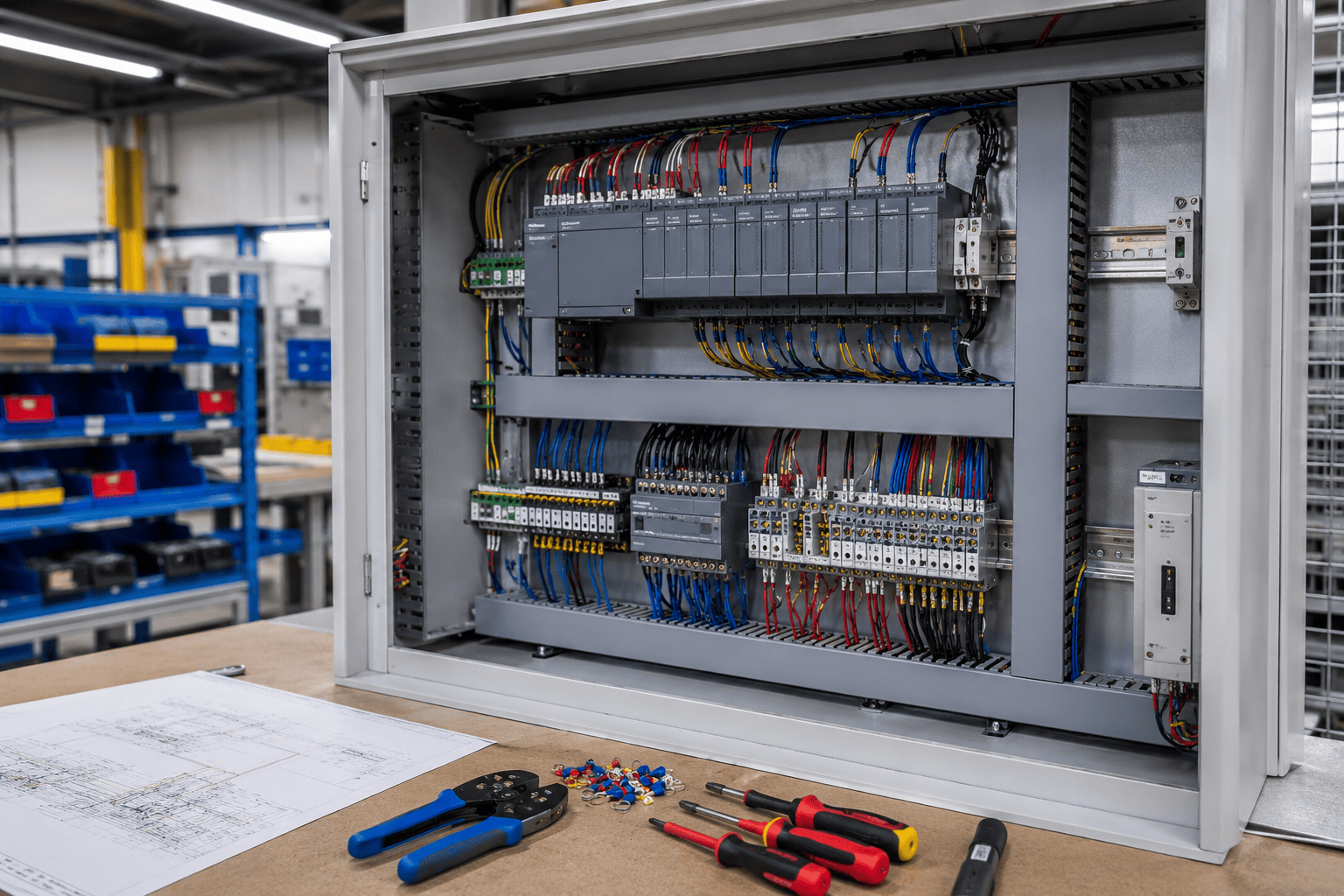
In india's rapidly expanding industrial ecosystem, a reliable industrial control panel is the nerve center of every automated facility. From automotive assembly lines in Chakan to pharmaceutical clean rooms in Hinjewadi and food processing plants in Ranjangaon, precisely engineered control panels determine whether production runs smoothly, safely, and profitably. As a premier industrial control panel manufacturer in india, Palladium Dynamics delivers end-to-end design, assembly, testing, and commissioning services that power Maharashtra's most demanding industrial applications.
Quick Answer
Palladium Dynamics is india's leading industrial control panel manufacturer, specializing in custom PLC automation panels, Motor Control Centers (MCC), VFD panels, power distribution boards, and SCADA control systems. We serve automotive, pharmaceutical, food processing, chemical, and general manufacturing industries across Chakan, Ranjangaon, Pimpri-Chinchwad, Hinjewadi, Bhosari, and Talawade. Our panels comply with IS/IEC 61439, IP54/IP65/IP66 ratings, and ATEX standards. Delivery typically spans 2–6 weeks with pricing from ₹25,000 for basic boards to ₹5,00,000+ for advanced PLC-SCADA systems.
What Is an Industrial Control Panel and Why Does It Matter?
An industrial control panel is an enclosed assembly of electrical components including programmable logic controllers (PLCs), circuit breakers, contactors, relays, variable frequency drives (VFDs), HMI terminals, and associated wiring that monitors, controls, and protects industrial machinery and processes. Unlike off-the-shelf electrical boards, industrial control panels are engineered to specification for a particular application, environment, and safety class.
For india's manufacturing sector, the consequences of a poorly designed control panel extend far beyond a single machine stoppage. A faulty panel can trigger unplanned downtime costing lakhs per hour on a high-speed automotive line, create safety hazards leading to personnel injuries and regulatory penalties, cause product quality failures in pharmaceutical or food applications, void equipment warranties and insurance coverage, and result in non-conformances during customer audits. Conversely, a well-designed, properly assembled control panel reduces maintenance interventions, extends equipment service life, improves energy efficiency through optimized motor control, and provides the data connectivity needed for Industry 4.0 initiatives.
The Shift Toward Smart Control Panels in india Industry
india's manufacturing base is rapidly evolving from conventional relay logic to intelligent, connected control architectures. Leading automotive tier-1 suppliers in Chakan and Ranjangaon are deploying PLC-based panels with OPC-UA connectivity, enabling real-time data exchange with MES and ERP systems. Pharmaceutical manufacturers in Hinjewadi require 21 CFR Part 11-compliant panels with audit trails and e-signatures built into the HMI layer. Food processing plants demand hygienic stainless steel enclosures with IP69K washdown ratings. Electronics manufacturers increasingly need panels with integrated vision system interfaces and servo drive coordination. Palladium Dynamics designs for all these evolving requirements, ensuring your panel investment remains relevant as technology advances.
Types of Industrial Control Panels We Manufacture in india
Control panel requirements vary dramatically across industries and applications. Understanding the primary panel types helps procurement and engineering teams specify the right solution from the outset, avoiding costly redesign cycles or capability mismatches.
PLC Automation Panels form the brain of modern manufacturing systems. These panels house programmable controllers from leading brands including Siemens, Allen-Bradley, Mitsubishi, Omron, Schneider, and Delta, along with associated I/O modules, communication gateways, and power supplies. PLC panels handle discrete control of conveyors, robotic cells, assembly machines, and packaging equipment. They support fieldbus protocols including PROFINET, EtherNet/IP, Modbus TCP, DeviceNet, and CANopen for integration with distributed I/O, variable speed drives, and safety controllers.
Motor Control Centers (MCCs) manage the starting, stopping, protection, and monitoring of electric motors throughout a facility. A well-engineered MCC incorporates properly rated contactors and overload relays, motor protection circuit breakers (MPCBs), soft starters or VFDs for controlled acceleration, power factor correction provisions, metering for energy monitoring, and bus ducts for efficient power distribution. MCCs for india's automotive facilities frequently incorporate intelligent motor management relays enabling predictive maintenance through current trending and thermal modeling.
Variable Frequency Drive (VFD) Panels control motor speed to optimize process efficiency and energy consumption. Fans, pumps, compressors, conveyors, and machine spindles all benefit from variable speed control. A properly assembled VFD panel addresses harmonic mitigation through line reactors or active front ends, thermal management ensuring adequate cooling in india's summer conditions, EMC compliance preventing interference with nearby control systems, and bypass provisions enabling continued operation during drive maintenance.
Power Distribution Boards (PDBs) distribute incoming supply across facilities and machines, incorporating metering, protection, and switching for each circuit. These boards range from simple sub-distribution panels to sophisticated power management systems with remote switching, energy metering, and SCADA connectivity for facilities monitoring programs.
SCADA and HMI Control Panels provide operator interfaces and supervisory control for complex processes including water treatment, chemical production, HVAC systems, and utility management. These panels integrate large-format HMI touchscreens, industrial PCs, network switches, and UPS systems, requiring careful thermal management and EMC design.
Safety Relay and Safety PLC Panels implement machine safety functions including emergency stop circuits, light curtain interfaces, safety door interlocks, two-hand controls, and enabling device circuits. Safety panels must comply with IEC 62061 and ISO 13849, with components achieving the required Safety Integrity Level (SIL) or Performance Level (PL) for the risk assessment outcome.
Palladium Dynamics: Premier Industrial Control Panel Manufacturer in india
Palladium Dynamics brings together mechanical design expertise, electrical engineering depth, software programming capability, and manufacturing discipline to deliver control panels that perform reliably from day one. Our ISO 9001:2015 certified processes govern every stage from initial specification through final commissioning, ensuring consistent quality on every project regardless of size or complexity.
Our Control Panel Design & Engineering Capabilities
World-class control panel manufacturing begins with rigorous engineering. Our design team uses industry-standard tools including EPLAN Electric P8 and AutoCAD Electrical for schematic development, Rittal Therm and thermal calculation software for enclosure sizing and cooling design, and SolidWorks for 3D mechanical layout visualization before physical assembly begins. This investment in engineering rigor prevents costly errors discovered late in the assembly or commissioning phase.
Schematic design follows IEC 60617 drawing conventions with clear identification of all components, terminals, cable entries, and earthing provisions. We produce complete documentation packages including single line diagrams, circuit schematics, terminal schedules, cable lists, bill of materials with approved alternatives, I/O schedules for PLC configuration, and enclosure arrangement drawings. This documentation supports maintenance, troubleshooting, and future modification throughout the panel's 20+ year service life.
Load calculations, short circuit analysis, and cable sizing follow IS/IEC standards ensuring proper component selection and system protection coordination. Thermal analysis for each enclosure determines cooling requirements, selecting between natural convection, forced air cooling with filtered fans, heat exchangers, or air conditioning units based on heat dissipation, ambient conditions, and ingress protection requirements.
Component Sourcing and Quality Assurance
Panel performance depends critically on component quality. Palladium Dynamics sources exclusively from authorized distributors of reputable brands, maintaining traceability from purchase order through panel delivery. We work with established brands including Siemens, ABB, Schneider Electric, Allen-Bradley, Mitsubishi, Omron, Phoenix Contact, Weidmuller, Rittal, Legrand, Havells, and L&T, selecting the appropriate brand based on customer preference, application requirements, and long-term spare parts availability in india's market.
Counterfeit components represent a serious risk in Indian industrial procurement. Our purchasing team verifies authenticity through authorized supply chains, conducting incoming inspection of critical components including PLCs, VFDs, contactors, and circuit breakers before they enter our assembly process. Certificates of conformity are retained for all major components, supporting customer audit requirements.
Assembly Standards and Workmanship
Our assembly facility in india maintains controlled conditions supporting consistent, high-quality panel construction. Skilled panel wiremen follow documented work instructions for cable dressing and routing, maintaining minimum bend radii and separation between power and control cables. Ferrule identification using heat-shrink printed ferrules ensures every wire end is labeled matching the schematic, eliminating ambiguity during commissioning and maintenance.
Terminal block wiring follows IEC 60947-7-1 requirements with appropriate torque applied using calibrated torque screwdrivers. DIN rail mounting of components follows manufacturer spacing recommendations ensuring adequate heat dissipation and maintenance access. Cable management uses plastic cable duct with appropriate fill ratios, maintaining organized, accessible wiring harnesses. Earth bonding follows IEC 60204-1 requirements with continuous low-impedance paths from all metallic enclosure components to the main earth bar.
Testing and Validation Before Delivery
Every control panel undergoes comprehensive testing before leaving our india facility. Our test protocols include insulation resistance testing at 500V DC verifying isolation between circuits and earth, high voltage (dielectric) testing for panels rated above 1000V, functional testing of all control circuits including interlocks, permissives, and alarm functions, simulation testing of all PLC program functions using signal simulators or test jigs, HMI screen navigation and alarm functionality verification, and communications testing verifying fieldbus connectivity and data exchange.
For panels requiring Factory Acceptance Testing (FAT) with customer witness, we prepare formal FAT procedures aligned with the design specification and customer requirements. FAT documentation including test records, punch list management, and sign-off sheets provides a comprehensive quality record accompanying the panel to site.
Industries Served: Control Panel Applications Across india's Manufacturing Sector
india's industrial diversity creates a rich variety of control panel applications, each with distinct requirements for electrical design, environmental protection, regulatory compliance, and operational integration. Our experience across these sectors enables us to anticipate industry-specific requirements and incorporate them proactively into panel designs.
Automotive Manufacturing and Tier Supply Chain
india's automotive corridor spanning Chakan, Ranjangaon, and Pimpri-Chinchwad represents one of India's most demanding environments for control panel performance. Production lines run continuously with minimal allowable downtime, requiring panel designs that prioritize reliability, serviceability, and rapid fault diagnosis. Automotive control panels from Palladium Dynamics incorporate redundant power supplies for critical control circuits, structured network architecture enabling deterministic communication, diagnostic capabilities providing maintenance teams with detailed fault information, and spare I/O capacity accommodating future process modifications without panel redesign.
IATF 16949 automotive quality requirements demand documented design validation, component traceability, and process control during panel manufacture. Our quality management system addresses these requirements directly, providing automotive customers with the documentation evidence needed for their supply chain audit compliance. Integration with robotic systems, vision systems, torque controllers, and leak testers forms a significant part of our automotive panel portfolio.
Pharmaceutical and Life Sciences Manufacturing
Pharmaceutical manufacturers in Hinjewadi and across india's pharmaceutical belt require control panels meeting stringent regulatory standards. GMP-compliant panel design considers equipment qualification requirements with panels designed and documented to support IQ/OQ/PQ protocols, 21 CFR Part 11 compliance for panels controlling validated processes requiring audit trails and electronic signatures, GAMP 5 software lifecycle requirements for panels with embedded PLC programs considered software Category 4 or 5, and hygienic design for panels installed in classified manufacturing areas.
Pharmaceutical panels often require stainless steel enclosures with smooth, crevice-free surfaces suitable for cleaning and disinfection, filtered pressurization preventing airborne contamination ingress, and sealed cable entry preventing pest entry and maintaining area classification integrity. Our experience with WHO GMP, EU GMP, and US FDA requirements enables pharmaceutical customers to achieve regulatory compliance efficiently.
Food and Beverage Processing
Food processing facilities in india's industrial areas require control panels meeting food safety standards including FSSC 22000, HACCP principles, and customer retailer standards. Stainless steel enclosures with IP65 or IP69K ratings withstand aggressive washdown procedures using high-pressure hot water and chemical sanitizers. Hygienic cable entry systems prevent harbourage of microorganisms. Component selection avoids materials that could become contaminants if damaged, and enclosure designs eliminate horizontal surfaces where product or cleaning fluid could accumulate.
VFD-based speed control of processing equipment including mixers, conveyors, filling machines, and packaging equipment forms a core element of food processing control systems. Energy monitoring integration supports sustainability reporting requirements increasingly demanded by food retailers and consumers.
Chemical and Process Industries
Chemical manufacturers and process industries in india require control panels engineered for hazardous area installation where flammable gases, vapors, dusts, or fibers may be present. ATEX Zone 1 and Zone 2 classified areas require Ex-d (flameproof), Ex-e (increased safety), or Ex-p (pressurized) enclosures certified by accredited testing bodies. Our engineering team designs hazardous area panels following IEC 60079 standards, selecting appropriate equipment protection levels and documenting compliance through ATEX certification documentation.
Intrinsically safe field instrument interfaces, zener barriers, and galvanic isolators for Zone 0 field instruments require careful design to maintain safety integrity. Documentation packages for hazardous area panels include Zone classification drawings, equipment schedules with Ex certification details, and inspection and maintenance procedures required by IS 5571 and IEC 60079-17.
General Manufacturing, Water Treatment, and Infrastructure
Beyond sector-specific applications, Palladium Dynamics supplies control panels for general purpose manufacturing including machine tools, press lines, material handling systems, utilities management including compressed air, cooling water, and HVAC systems, and infrastructure applications including pumping stations, water treatment, and substation automation. These diverse applications benefit from our broad technical experience and flexible design approach.
Comprehensive Pricing Guide: Industrial Control Panels in india
Control panel pricing in india's market varies considerably based on panel type, complexity, component specifications, enclosure requirements, and testing scope. Understanding cost drivers enables accurate budgeting and meaningful comparison of supplier proposals.
Simple Power Distribution Boards and Relay Panels
Basic power distribution boards and relay logic control panels for simple machinery represent the entry point of our panel range, typically priced between ₹25,000 and ₹80,000. These panels incorporate standard MCBs and contactors, basic relay logic for interlocking, standard mild steel powder-coated enclosures with IP54 rating, terminal blocks and cable ducting following standard practice, and simple functional testing before dispatch. These solutions suit light machinery, utility sub-distribution, and non-critical applications where automation complexity is minimal.
PLC-Based Automation Panels
PLC automation panels for production machinery, conveyor systems, and process control typically range from ₹1,50,000 to ₹4,00,000 depending on PLC platform, I/O count, HMI integration, and communication requirements. This category covers compact PLCs with 32-128 I/O points, 7" to 15" HMI touchscreen integration, standard fieldbus communication modules, IP54 to IP65 enclosures depending on environment, PLC programming included for defined functionality, and Factory Acceptance Testing with customer witness. Many india manufacturers investing in their first automation upgrade begin here, establishing a foundation for future expansion.
Motor Control Centers (MCCs)
Motor Control Centers for facilities with multiple motors typically range from ₹80,000 to ₹3,00,000+ depending on feeder count, motor ratings, protection sophistication, and energy monitoring requirements. Standard MCCs in this range include 4 to 16 motor feeders with DOL or star-delta starters, motor protection circuit breakers and thermal overload relays, main incomer with metering, bus bars for power distribution, and standard powder-coated steel enclosures. Intelligent MCCs with soft starters, VFDs, motor management relays, and network communication capability occupy the upper end of this range and above.
Advanced SCADA and Integrated Control Systems
Complex integrated control systems incorporating multiple PLCs, SCADA servers, industrial networking infrastructure, and sophisticated HMI systems typically range from ₹3,00,000 to ₹10,00,000 or more for large process control applications. These systems serve water treatment plants, chemical process facilities, large-scale HVAC systems, and complex manufacturing automation requiring centralized supervisory control.
| Panel Type | Typical Price Range (india) | Best For | Lead Time |
|---|---|---|---|
| Power Distribution Board / Relay Panel | ₹25,000 – ₹80,000 | Light machinery, sub-distribution, utilities | 10–15 working days |
| PLC Automation Panel | ₹1,50,000 – ₹4,00,000 | Production machinery, conveyors, packaging | 3–5 weeks |
| Motor Control Center (MCC) | ₹80,000 – ₹3,00,000+ | Multi-motor applications, process plants | 3–6 weeks |
| VFD Drive Panel | ₹60,000 – ₹2,50,000 | Pumps, fans, compressors, conveyors | 2–4 weeks |
| SCADA / Integrated Control System | ₹3,00,000 – ₹10,00,000+ | Process plants, water treatment, large facilities | 6–10 weeks |
Key Cost Drivers for Control Panels in india
Understanding what drives cost variation helps procurement teams structure specifications effectively and evaluate competing proposals on a like-for-like basis.
PLC and Drive Brand Selection significantly impacts panel cost. Siemens S7-1500 and Allen-Bradley ControlLogix occupy the premium segment with robust ecosystem support and long-term parts availability, while Mitsubishi iQ-R, Omron NX/NJ, and Schneider Modicon M340/M580 offer competitive capability at mid-range pricing. Delta, Kinco, and other Asian brands provide cost-effective solutions for less demanding applications. The right choice balances initial cost, lifecycle cost, local support availability, and customer preferences.
Enclosure Specification affects cost substantially. Standard mild steel powder-coated enclosures (Rittal, Belden, or equivalent) represent baseline cost. Stainless steel 304 or 316 enclosures for pharmaceutical or food applications add 40-70% to enclosure cost. ATEX-certified enclosures for hazardous areas command significant premiums depending on certification category and enclosure size. IP rating upgrades from IP54 to IP65 add modest cost through enhanced gasketing and cable entry selection, while IP66 and IP69K ratings add more through specialized construction.
Testing and Documentation Scope influences overall project cost but delivers significant value. Factory Acceptance Testing with customer witness requires test procedure preparation, test execution time, and defect rectification before sign-off. IQ/OQ documentation packages for pharmaceutical customers require substantial engineering effort but are mandatory for qualified systems. Third-party testing and certification for export panels or safety-critical applications adds cost while opening market access.
Site Installation and Commissioning services, where included, typically add 15-30% to panel supply cost but ensure correct installation, proper commissioning of all functions, and operator training accelerating productive use of the new system. Many india manufacturers prefer a turnkey approach including these services for critical automation projects.
Design Process: From Specification to Commissioned Panel
Palladium Dynamics follows a structured project management approach ensuring every control panel project progresses predictably from initial specification through final handover. Understanding this process helps customers plan project timelines and prepare the information needed at each stage.
Phase 1: Requirements Capture and Technical Specification (Week 1)
Every successful control panel project begins with thorough requirements capture. Our engineers engage with your production, electrical, and maintenance teams to understand the process or machine being controlled in detail, available power supply characteristics including voltage, phases, and fault level, environmental conditions including temperature range, humidity, contamination exposure, and wash-down requirements, applicable standards including industry-specific requirements and customer specifications, connectivity requirements to existing systems including PLCs, SCADA, MES, and ERP platforms, and future expansion plans that should be accommodated in the initial design.
From this engagement, we develop a Technical Specification document defining the panel scope clearly. Customer review and approval of the Technical Specification before detailed design begins prevents costly changes later in the project, a discipline we enforce on every engagement regardless of schedule pressure.
Phase 2: Detailed Engineering Design (Weeks 1–3)
Approved specifications drive detailed engineering covering electrical schematic design using EPLAN Electric P8, with all circuits drawn to IEC 60617 conventions. Mechanical layout design positions components in the enclosure optimizing wiring accessibility, thermal performance, and maintenance ergonomics. Bill of materials generation with specific part numbers enables accurate purchasing and establishes the baseline for component traceability. Cable schedule preparation identifies every cable by number, type, size, routing, and termination details at both ends. I/O schedule development maps each physical signal to its PLC channel, engineering unit, and scaling, forming the basis for PLC configuration and program development.
Design review with customer engineering teams prior to manufacturing release catches specification gaps and design errors when correction costs are minimal. We encourage thorough review at this stage rather than discovering issues during FAT or commissioning.
Phase 3: Component Procurement and Assembly (Weeks 2–5)
Following design approval, component procurement begins immediately to compress overall project timeline. Our established relationships with authorized distributors in india enable rapid procurement of standard components, while long-lead items such as large PLCs, specialized VFDs, or stainless steel enclosures are identified early and ordered to protect the project schedule.
Assembly begins with enclosure preparation including drilling, punching, and painting of any customer-specific features not available from standard enclosure manufacturers. DIN rail and cable duct installation creates the physical infrastructure for component mounting. Component installation follows the approved layout drawing with inter-row spacing maintained for thermal performance and maintenance access. Wiring proceeds following the approved schematic, with all wires identified with printed ferrules matching schematic wire numbers at every termination point.
Phase 4: Testing and Factory Acceptance (Weeks 4–6)
Completed panels undergo internal quality inspection against a detailed checklist before formal testing begins. Internal inspection verifies component installation matches the bill of materials, wiring matches the approved schematic, all terminations are properly torqued, cable identification is complete and correct, earth bonding continuity is verified, enclosure integrity is confirmed including gaskets, door hardware, and cable entries, and documentation inside the panel matches the as-built configuration.
Testing follows our documented test procedures covering insulation resistance testing, functional testing of all control circuits, PLC program functional testing using simulation, HMI functionality testing, and communications verification. For customer FAT, we prepare formal test procedures in advance, allowing customer review and approval before the test date. FAT punch list items are addressed during or immediately after FAT, with sign-off obtained before panel preparation for delivery.
Phase 5: Delivery, Site Installation, and Commissioning
Panels are carefully packed for transport to protect components and finished surfaces during delivery across india and Maharashtra. For fragile or complex panels, we provide detailed handling and installation instructions including lifting points, tilt restrictions, and installation sequence for multi-panel lineups.
Site commissioning services include panel installation supervision, power-on verification, field instrument and device termination testing, I/O loop checking verifying correct signal flow from field to PLC, functional testing of all control functions in the actual process environment, operator interface configuration and testing, and initial operator training on panel operation. Commissioning completion is documented with a commissioning report capturing test results and any open items for follow-up.
Compliance Standards: What Your Control Panel Must Meet
Indian and international standards govern control panel design, assembly, and testing. Understanding applicable standards ensures your panel investment meets regulatory requirements, satisfies insurance and certification bodies, and withstands customer audit scrutiny.
IS/IEC 61439: Low-Voltage Switchgear and Control Gear Assemblies
IS/IEC 61439 is the primary standard governing design and manufacture of low-voltage switchgear and control gear assemblies including control panels. The standard defines requirements for design verification covering temperature rise, dielectric properties, short circuit withstand, protective circuit effectiveness, clearances and creepage distances, mechanical operation, and IP degree of protection. Assembly verification confirms correct implementation of the verified design during manufacture. IS/IEC 61439 replaced the previous IS/IEC 60439 standard, and panels for most industrial applications should comply with the current standard.
Compliance with IS/IEC 61439 requires either original design verification through testing of a representative assembly, or verification by derivation comparing the actual assembly against a verified reference design. Palladium Dynamics maintains design verification documentation enabling us to certify panels to IS/IEC 61439 by derivation for standard configurations, with testing of new designs as required.
IS/IEC 60204-1: Safety of Machinery Electrical Equipment
IS/IEC 60204-1 specifies requirements for electrical equipment of machines including control panels, covering incoming supply disconnection, protection against electric shock, protection of equipment, control circuits and functions, operator interface and control devices, controlgear assemblies, conductors and cables, electric motors and associated equipment, accessories and lighting, markings, warnings, and technical documentation. Control panels for machine tool, press, conveyor, and general machinery applications must comply with IEC 60204-1, which forms the basis for CE marking of machinery exported to the European market.
IP Ratings: IEC 60529 Ingress Protection
IP ratings define the degree of protection provided by an enclosure against solid particle ingress and water ingress. Selection of appropriate IP rating depends on the installation environment. IP54 suits most indoor industrial environments with some dust and occasional water splash. IP65 is required for outdoor installation or indoor environments with regular water spray. IP66 provides protection against powerful water jets suitable for outdoor switchgear and process area installation. IP67 and IP68 cover immersion applications. IP69K is required for high-pressure, high-temperature washdown applications in food processing and pharmaceutical facilities. Our enclosure designs are validated for the specified IP rating through appropriate sealing, gasketing, and cable entry selection.
IEC 62061 and ISO 13849: Functional Safety
Control panels incorporating safety functions including emergency stop circuits, safety door interlocks, two-hand controls, and enabling devices must comply with IEC 62061 (for electrical, electronic, and programmable electronic safety systems) or ISO 13849 (for safety-related parts of control systems). These standards require risk assessment to determine the required Safety Integrity Level (SIL) or Performance Level (PL), component selection meeting architectural requirements for the required SIL/PL, calculation of hardware reliability metrics, systematic capability assessment of software if safety PLC is used, and validation testing confirming correct safety function operation. Palladium Dynamics designs functional safety into control panels from initial specification, rather than attempting to retrofit safety analysis onto completed designs.
ATEX Certification for Hazardous Areas
Facilities with flammable gases, vapors, mists, or dusts require control panels certified for installation in classified hazardous areas. ATEX directive 2014/34/EU (followed as best practice in India per PESO and CCOE requirements) requires equipment conforming to IEC 60079 series standards. Zone 1 areas require Ex-d flameproof, Ex-e increased safety, or Ex-p pressurized and purged enclosures with appropriate certification. Zone 2 areas allow additional protection concepts including Ex-n. All ATEX equipment must carry certification from a notified body and be properly documented in the area dossier maintained by the facility. Our ATEX panel designs incorporate certified enclosures, Ex-certified cable entries, and internal components meeting the relevant protection concept, with full certification documentation.
Choosing the Right Control Panel Manufacturer in india: Key Evaluation Criteria
The india market includes numerous control panel manufacturers ranging from single-person workshops to established engineering companies. Selecting the right partner for your project requires evaluating capabilities, quality systems, experience, and support commitment systematically.
Engineering Depth and Design Tools
Ask prospective manufacturers to demonstrate their design tools and capabilities. Professional manufacturers use dedicated electrical CAD tools such as EPLAN or AutoCAD Electrical generating consistent, error-checked schematics rather than generic CAD or manually drafted drawings. Inquire about their approach to load calculations, short circuit analysis, and thermal design. Request examples of their documentation packages to evaluate completeness and professionalism. A manufacturer relying on copied or borrowed documentation rather than original engineering is a significant risk.
Quality Management System and Certifications
ISO 9001:2015 certification demonstrates that a manufacturer has implemented systematic quality management covering document control, purchasing, manufacturing, testing, and continuous improvement. While certification alone does not guarantee quality, its absence in a panel manufacturer serving demanding industrial applications warrants caution. Request audit history and recent surveillance audit results to verify active compliance rather than a paper certification. Ask about component traceability systems, incoming inspection procedures, and how nonconformances are managed and prevented from recurring.
Assembly Facility and Workforce
A site visit to a prospective manufacturer's assembly facility reveals much that specification documents cannot. Observe the cleanliness and organization of the work area, indicating the quality culture of the organization. Review actual panels in progress or recently completed to evaluate wiring quality, component layout, and labeling standards. Ask about wireman training and qualification, as skilled panel wiremen are the foundation of quality assembly. Inquire about calibration of torque tools and test equipment, as uncalibrated tools cannot ensure reliable assembly quality.
Testing Capability and Equipment
Verify that the manufacturer possesses and uses appropriate test equipment for panel verification. Essential equipment includes insulation resistance tester (Megger), continuity tester, calibrated torque screwdrivers, and basic electrical measurement instruments. PLC panel manufacturers should possess programming laptops with licensed software for all supported PLC platforms, I/O simulation equipment for program testing, and HMI configuration capability. Manufacturers supporting hazardous area panels should demonstrate familiarity with ATEX inspection requirements.
Project Management and Communication
Control panel projects involve numerous decision points requiring clear communication between customer and manufacturer. Evaluate how prospective manufacturers handle project documentation, change management, and schedule reporting. A manufacturer who provides detailed project plans, regular status updates, and prompt responses to technical queries significantly reduces project risk compared to one who operates reactively. Request references from india manufacturers who have purchased panels from the supplier and speak with them about actual project experience.
After-Sales Support and Spares Availability
A control panel's value is realized over its 20+ year service life, not just at commissioning. Evaluate the manufacturer's after-sales support commitment including availability for emergency fault response, spares holding for common wear items, documentation updates for panel modifications, support for PLC program changes as process requirements evolve, and long-term relationships enabling cost-effective future upgrades. Palladium Dynamics maintains long-term relationships with our india customers, providing ongoing support as their operations grow and evolve.
Frequently Asked Questions About Control Panel Design & Assembly in india
What information do I need to provide to get a control panel quotation?
To provide an accurate quotation, we typically need a description of the machine or process being controlled, the number and type of input and output signals (digital and analog), motor count, ratings, and starting method requirements, available supply voltage and phase, installation environment including IP rating requirements, applicable standards and customer specifications, PLC brand preference or openness to recommendation, HMI requirements including screen size and functionality, testing and documentation requirements, and target delivery date. Even partial information enables a budgetary estimate, with detailed specifications developed during the design phase. Contact our team for a guided specification discussion where our engineers help you identify all relevant requirements.
Can you supply a control panel for a specific PLC brand our maintenance team knows?
Yes, absolutely. We design and assemble panels around customer-specified PLC platforms including Siemens, Allen-Bradley, Mitsubishi, Omron, Schneider, Delta, and others. Using a platform your maintenance team knows reduces training requirements and accelerates fault resolution. If you are open to recommendations, we can suggest the most appropriate platform based on application requirements, local support availability, and total lifecycle cost considerations. Our programming engineers hold certifications across multiple PLC platforms enabling us to provide high-quality program development regardless of the specified platform.
Do you provide the PLC programming as well as panel hardware?
Yes, Palladium Dynamics provides complete turnkey automation solutions including panel hardware, PLC and HMI programming, site installation, and commissioning. We can also supply panel hardware only where customers prefer to handle programming internally or use their preferred programming supplier. For turnkey projects, our programming team works from the same functional specification driving the panel design, ensuring tight integration between hardware and software and eliminating interface risks. SCADA and MES integration are also available as part of comprehensive automation projects.
How do you handle panel modifications for changes in machine requirements after delivery?
Process requirements evolve throughout a facility's operational life, and control panels must evolve with them. We maintain complete as-built documentation for every panel we supply, enabling accurate modification engineering even years after original delivery. Modifications are engineered through the same design review process as new panels, ensuring compliance with applicable standards and compatibility with existing systems. Modified documentation including revised schematics, updated component lists, and supplementary test records is provided with every modification. We recommend engaging the original panel manufacturer for modifications where possible, as familiarity with the original design accelerates modification engineering and reduces risk of unintended interactions.
What is the typical warranty for industrial control panels supplied in india?
Palladium Dynamics provides a 12-month warranty covering defects in materials and workmanship from the date of commissioning or 18 months from delivery date, whichever is earlier. Warranty covers replacement or repair of defective components and corrective action for assembly defects at no cost to the customer. Component manufacturer warranties are passed through where they exceed our standard terms, providing extended coverage for major components such as PLCs, VFDs, and HMI systems which typically carry 24-month manufacturer warranties. Warranty exclusions include damage from misuse, incorrect installation by others, power quality disturbances beyond specified limits, and unauthorized modifications.
Can you supply panels meeting export standards for our overseas customers?
Yes, we design and assemble panels for export applications meeting UL 508A (USA and Canada), CE marking under Low Voltage Directive and Machinery Directive (European Union), and customer-specific export standards. UL 508A panels require use of UL-listed components throughout and compliance with specific wiring practices and marking requirements. CE marking requires design to harmonized standards including EN 61439 and EN 60204-1, compilation of a Technical Construction File, and Declaration of Conformity. Export panels typically carry premium pricing reflecting the additional engineering, documentation, and certification effort, but enable india manufacturers to supply equipment globally and support multinational customers' standardized specifications.
How should I prepare my facility for control panel installation?
Advance preparation significantly reduces commissioning time and cost. Key preparation steps include completing civil works for panel room or installation area including cable trenches, conduit, and cable trays, ensuring adequate structural support for panel weight, completing incoming supply cable installation to panel room, installing earthing infrastructure including earth electrode and main earth bar, preparing cable schedules identifying all field cables connecting to the panel, and training operators on basic panel operation concepts before commissioning begins. Our commissioning team provides a detailed pre-commissioning checklist during the project, allowing preparation to proceed in parallel with panel manufacture to compress the overall project timeline.
Ready to Discuss Your Control Panel Requirements in india?
Contact Palladium Dynamics for expert consultation on industrial control panel design, assembly, and commissioning services tailored to your facility. Serving automotive, pharmaceutical, food processing, chemical, and general manufacturing industries across india, Chakan, Ranjangaon, Pimpri-Chinchwad, Hinjewadi, and throughout Maharashtra.
The ROI of Investing in Quality Control Panel Design & Assembly
Procurement decisions for control panels frequently focus on initial purchase price, creating a false economy that becomes apparent only during operation. The true cost of a control panel spans its entire operational life, and quality engineering at the outset delivers measurable financial returns that dwarf any initial price premium.
Consider a typical scenario in a india automotive tier-1 supplier. A production line running 20 hours daily generates ₹8,00,000 of output per hour. An undersized, poorly designed control panel requiring 4 unplanned stoppages per year at 3 hours each costs ₹96,00,000 in lost production annually, plus ₹2,00,000 in emergency maintenance labor and expedited spare parts. A properly engineered panel from a capable manufacturer adds ₹50,000 to the purchase price but delivers zero unplanned stoppages attributable to panel design deficiencies, recovering its premium in the first incident it prevents.
Beyond immediate uptime impact, quality control panel design provides long-term value through reduced energy consumption via properly sized and configured VFDs and motor protection, extended motor and driven equipment life through precise speed and torque control, faster fault diagnosis reducing mean time to repair through comprehensive diagnostics, accommodation of process changes without panel redesign through adequate spare capacity, and easier maintenance through well-organized, clearly labeled, accessible wiring.
For india manufacturers pursuing Industry 4.0 integration, data connectivity built into control panels from the outset avoids costly retrofit projects. OPC-UA servers, MQTT brokers, and cloud connectivity provisions incorporated in the original panel design enable digital transformation initiatives at marginal incremental cost, while adding these capabilities later requires panel modification, production downtime, and engineering rework.
Conclusion: Building india's Industrial Future with Expert Control Panel Engineering
Industrial control panels are not commodity products. They are precisely engineered systems whose performance directly determines the productivity, safety, quality, and competitiveness of the manufacturing facilities they serve. For india's manufacturers competing in automotive, pharmaceutical, food processing, and export-oriented industries, the choice of control panel manufacturer is a strategic decision with long-term operational consequences.
Palladium Dynamics brings the engineering capability, manufacturing discipline, quality systems, and industry experience to deliver control panels that perform reliably from commissioning through a full operational lifetime. Our ISO 9001:2015 certified processes, comprehensive design documentation, rigorous testing protocols, and commitment to after-sales support give india manufacturers the confidence that their control panel investment is protected.
As india's manufacturing base advances toward smarter, more connected, more efficient production, control panels are evolving from simple machine controllers to intelligent nodes in a digital manufacturing network. Our engineering team stays at the forefront of this evolution, incorporating IIoT connectivity, edge computing, cloud integration, and predictive maintenance capabilities into panel designs that serve not only today's requirements but tomorrow's ambitions.
Whether you need a straightforward power distribution board for a new utility circuit, a sophisticated PLC automation panel for a new production line, a compliant safety panel for machinery CE marking, or a complete integrated control system for a new facility, Palladium Dynamics has the expertise and capacity to deliver. We invite india manufacturers to engage our engineering team early in project planning, allowing us to contribute technical expertise that shapes the solution for optimal performance, compliance, and value.
The right control panel, engineered and assembled by a capable manufacturer, is an investment in your facility's operational excellence. Contact Palladium Dynamics today to begin the conversation about how our industrial control panel design and assembly services can strengthen your production operations across india and Maharashtra.