
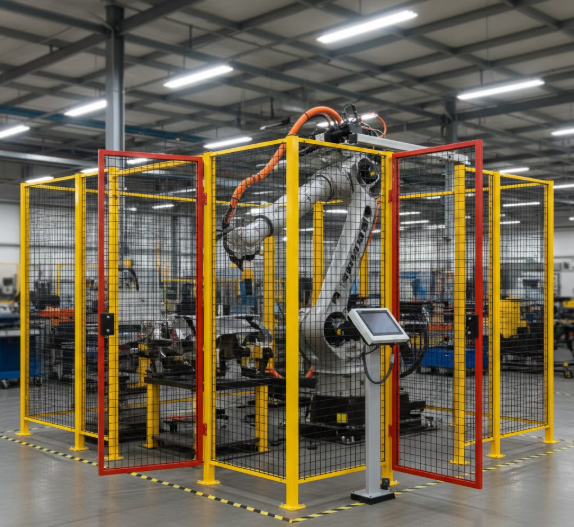
Industrial robots have revolutionized manufacturing across industries, bringing unprecedented levels of efficiency, precision, and productivity to production floors worldwide. However, these powerful automated systems also introduce significant safety challenges that must be systematically addressed to protect workers and maintain regulatory compliance. The cornerstone of industrial robot safety is perimeter safety fencing a critical protective barrier that separates human workers from robotic work cells while enabling seamless manufacturing operations.
As manufacturing facilities increasingly adopt collaborative and traditional industrial robots, understanding the principles, standards, design considerations, and best practices for implementing effective perimeter safety fencing has become essential for safety managers, facility engineers, and manufacturing leaders. This comprehensive guide explores every aspect of perimeter safety fencing for industrial robots, providing actionable insights for creating safer automated work environments.
Understanding Perimeter Safety Fencing: The Foundation of Robot Safety
Perimeter safety fencing for industrial robots serves as the primary physical safeguard separating automated robotic operations from human workers. Unlike simple barriers or visual markers, properly designed perimeter fencing creates a defined protective envelope around robotic work cells, preventing unauthorized access while maintaining necessary operational visibility and material flow.
The Critical Role of Perimeter Fencing in Industrial Automation
Industrial robots operate with tremendous force, speed, and repeatability characteristics that make them invaluable for manufacturing but potentially hazardous to human workers. A typical six-axis industrial robot can exert forces exceeding several hundred kilograms while moving at speeds over two meters per second. When carrying tools, workpieces, or end effectors, the potential for serious injury from collision becomes significant.
Perimeter safety fencing addresses multiple critical safety functions:
- Physical Barrier Protection: Creates a solid boundary preventing inadvertent contact between workers and moving robotic equipment
- Access Control: Establishes controlled entry points with safety interlocks ensuring robot operations cease when human access is required
- Visual Delineation: Clearly marks the boundary between automated and manual work zones, establishing clear operational protocols
- Integration Platform: Provides mounting structure for safety sensors, emergency stops, signage, and other protective devices
- Regulatory Compliance: Demonstrates adherence to occupational safety standards and robotic safety regulations
- Risk Mitigation: Reduces liability exposure by implementing engineering controls as part of comprehensive safety programs
Key Components of Effective Perimeter Safety Fencing Systems
Comprehensive perimeter fencing systems integrate multiple components working together to create robust protection:
- Structural Framework: Rigid posts and horizontal members anchored to the facility floor, typically constructed from steel tubing or aluminum extrusions
- Barrier Panels: Mesh, polycarbonate, or solid panels filling the frame openings, selected based on visibility requirements and specific hazards
- Safety-Interlocked Gates: Access doors equipped with position switches or safety locks that trigger robot shutdown when opened during operation
- Emergency Stop Devices: Mushroom-head pushbuttons positioned at strategic locations enabling immediate cessation of robotic motion
- Safety Light Curtains: Optoelectronic presence-sensing devices creating virtual barriers at access points or material flow openings
- Safety Mats: Pressure-sensitive floor surfaces that detect human presence and trigger safety responses
- Visual Indicators: Beacon lights displaying operational status (running, stopped, error conditions) visible outside the cell
- Warning Signage: Standardized safety signs communicating hazards, entry restrictions, and emergency procedures
- Safety Controllers: Dedicated safety-rated PLCs or relay modules managing interlocks, emergency stops, and robot interface signals
International Standards Governing Perimeter Safety Fencing for Industrial Robots
Implementing compliant perimeter safety fencing requires understanding and adherence to multiple international safety standards specifically addressing industrial robot applications. These standards provide technical guidance on risk assessment, safety distances, guarding requirements, and electrical integration.
ISO 10218: Safety Requirements for Industrial Robots
ISO 10218 stands as the primary international standard governing industrial robot safety, divided into two parts addressing different stakeholder responsibilities. Part 1 covers robot manufacturers' requirements, while Part 2 addresses integrators and end users implementing robot systems.
Key requirements from ISO 10218 relevant to perimeter fencing include:
- Safeguarding Principles: Mandates implementation of protective measures preventing human contact with moving robot components during automatic operation
- Collaborative Operation Zones: Defines four distinct collaborative operational modes with specific safeguarding requirements for each
- Space Requirements: Specifies minimum separation distances between robots, fixed hazards, and perimeter boundaries based on maximum robot reach
- Access Points: Requires interlocked gates with position monitoring ensuring robot whenever access is granted
- Safety-Rated Monitoring: Mandates safety-rated control systems for managing protective devices with appropriate performance levels
- Emergency Stop: Requires strategically positioned emergency stop devices accessible from all operational and teaching positions
ISO 13857: Safety Distances to Prevent Hazard Zones Being Reached
This critical standard provides dimensional data for calculating minimum safety distances between guards and hazard zones. Proper application ensures perimeter fencing is positioned sufficiently far from moving robot components that workers cannot reach through or over barriers to contact hazards.
ISO 13857 establishes distance requirements based on:
- Opening sizes in fencing (mesh spacing, gaps under guards)
- Guard heights and reach-over capabilities
- Lower limb access preventing foot or leg insertion
- Anthropometric data for various body sizes and ages
ANSI/RIA R15.06: American National Standard for Industrial Robots and Robot Systems
The Robotic Industries Association (RIA) standard provides comprehensive requirements specific to North American installations, offering detailed guidance complementing ISO standards while addressing regional regulatory requirements.
ANSI/RIA R15.06 establishes requirements for:
- Risk Assessment: Systematic methodology for identifying hazards and implementing appropriate safeguards
- Safeguarding Devices: Performance specifications for barriers, presence-sensing devices, and interlocks
- Maximum Reach Envelopes: Calculations determining required perimeter fence positioning based on robot capabilities
- Operator Interface: Requirements for teach pendants, mode selection, and operational controls
- Testing and Validation: Procedures for verifying safety system functionality before production use
IEC 60204-1: Safety of Machinery - Electrical Equipment of Machines
This standard addresses electrical safety aspects of machinery including proper wiring, control circuits, and emergency stop functions. Perimeter safety fencing electrical integration must comply with IEC 60204-1 requirements ensuring reliable safety circuit operation.
ISO 12100: Safety of Machinery - General Principles for Design
Providing overarching guidance on machine safety philosophy, ISO 12100 establishes the risk reduction hierarchy: inherent safe design, engineering controls (including guards), and administrative controls with personal protective equipment. Perimeter fencing represents an engineering control measure within this framework.
Comprehensive Risk Assessment: Foundation for Effective Fencing Design
Successful perimeter safety fencing implementation begins with thorough risk assessment identifying specific hazards present in robotic work cells. This systematic process ensures fencing design appropriately addresses actual risks rather than applying generic solutions.
Hazard Identification for Robotic Work Cells
Common hazards requiring consideration include:
- Impact and Crushing: Robot collision with workers or entrapment between robot and fixed structures
- Shearing and Cutting: Hazards from end effectors including grippers, welding torches, cutting tools, and spray guns
- Entanglement: Rotating components like spindles, rotary actuators, or conveyor systems catching clothing or body parts
- Ejection of Parts: Workpieces, tools, or debris propelled from the work cell during operations
- Energy Release: Compressed air discharge, hydraulic system failures, or electrical arc flash events
- Environmental Hazards: Welding radiation, chemical spray exposure, high noise levels, or extreme temperatures
- Material Handling: Autonomous guided vehicles (AGVs), conveyors, or lifting devices integrated with robotic cells
Severity and Probability Assessment
Following hazard identification, assess potential injury severity (from minor cuts to fatal accidents) and occurrence probability (frequent, probable, occasional, remote, or improbable). This analysis guides selection of appropriate safeguarding measures with required safety performance levels (PLr) according to ISO 13849-1.
Determining Required Performance Levels
Based on risk assessment outcomes, safety systems including perimeter fencing and associated devices must achieve specific performance levels:
- PLa: Low risk applications with minor injury potential
- PLb: Moderate risk with reversible injuries possible
- PLc: Significant risk requiring robust safety measures
- PLd: High risk applications with serious injury potential
- PLe: Very high risk scenarios requiring maximum safety integrity
Most industrial robot applications require PLc or PLd, necessitating safety-rated components, redundant systems, and regular functional testing.
Design Principles for Perimeter Safety Fencing Systems
Effective perimeter safety fencing balances multiple objectives: maximum worker protection, operational efficiency, material flow accommodation, maintenance accessibility, and regulatory compliance. Achieving this balance requires careful attention to design fundamentals.
Establishing Safety Distances and Work Envelopes
The foundation of fencing layout is determining minimum safety distances from the robot's maximum reach envelope to fence positioning. This calculation considers:
- Robot Specifications: Maximum reach radius including tool length and workpiece dimensions
- Detection Time: Duration required for safety systems to detect intrusion and stop robot motion
- Stopping Performance: Time and distance for robot to achieve safe stop after receiving stop command
- Approach Speed: Velocity at which a person might approach the hazard zone
- Safety Margin: Additional buffer distance accounting for measurement uncertainties and deflection
The formula for minimum safety distance (S) typically follows: S = (K × T) + C, where K represents approach speed, T is total response time (detection + stopping), and C is a constant based on intrusion depth before detection.
Fence Height Determination
Fence height must prevent workers from reaching over barriers to contact hazards. Standard heights typically range from 1800mm to 2400mm depending on risk assessment outcomes and robot positioning relative to the floor. When robots are mounted on elevated platforms or pedestals, additional height may be necessary.
Consider these factors when determining fence height:
- Elevated robot mounting requiring taller barriers
- End effector tooling extending above standard robot reach
- Adjacent walkways, stairs, or platforms providing elevated access
- Overhead conveyors, cranes, or material handling crossing the cell
- Potential for stacking boxes or equipment near fencing
Panel Material Selection
Choose fencing panel materials based on specific application requirements:
- Wire Mesh Panels: Most common option providing excellent visibility, durability, and ventilation. Mesh size must comply with ISO 13857 preventing finger or limb insertion. Typical specifications include 50x50mm or 20x20mm welded wire with 3-5mm wire diameter.
- Expanded Metal: Alternative to wire mesh offering higher rigidity and structural strength. Suitable for heavy-duty applications or where enhanced protection is needed.
- Perforated Sheet Metal: Solid metal sheets with regular hole patterns providing security while maintaining some visibility and air circulation.
- Polycarbonate Panels: Clear plastic panels offering unobstructed process visibility for quality monitoring, training, or demonstration purposes. Provides sound attenuation benefits but requires anti-scratch coatings and UV stabilization.
- Solid Metal Panels: Complete opacity for applications requiring containment of light (welding flash), noise reduction, or particle containment (grinding, shot blasting).
- Hybrid Combinations: Lower solid sections (preventing parts ejection) with upper mesh or polycarbonate sections (providing visibility).
Gate Placement and Configuration
Access gates represent the most critical component of perimeter fencing systems, requiring careful consideration of operational requirements and safety interlocks.
Gate design considerations include:
- Location: Position gates for convenient access to teaching pendants, maintenance points, and workpiece loading zones while minimizing safety circuit complexity
- Size: Adequate dimensions for material handling equipment, tooling changes, and emergency personnel access while limiting unnecessary exposure
- Opening Direction: Swing direction preventing gate obstruction of work areas or egress paths
- Interlock Type: Safety switch selection (mechanical, magnetic, or RFID) based on required performance level and tamper resistance needs
- Trapped Key Systems: Mechanical interlocking preventing simultaneous robot operation and human access for high-risk applications
- Safety Hinges: Continuous or piano hinges preventing finger pinch points and providing robust connection
Safety Interlock Systems and Control Integration
Perimeter fencing effectiveness depends entirely on properly designed and implemented safety interlock systems that ensure robots before human access is possible. This electrical and control integration represents the "brains" behind physical barriers.
Safety Interlock Device Selection
Multiple technologies are available for monitoring gate position and triggering safety responses:
- Mechanical Safety Switches: Physical contact devices activated by gate movement. Available in various form factors including tongue interlocks, locking switches, and hinge switches. Suitable for most applications requiring up to PLd.
- Magnetic Safety Switches: Non-contact devices using coded magnetic fields resistant to tampering and contamination. Ideal for harsh environments with dust, oil, or frequent cleaning requirements.
- RFID Safety Switches: Radio frequency identification devices offering highest security through unique coding virtually impossible to defeat. Required for PLe applications or high-security installations.
- Trapped Key Interlocks: Mechanical systems using physical keys ensuring only one operational mode (robot running OR gate open) is possible at any time. Provides absolute safety but limits operational flexibility.
Safety Controller Architecture
Safety-rated controllers manage inputs from perimeter fencing devices and control robot system responses. Modern safety controllers typically employ dual-channel architectures with cross-monitoring ensuring single faults cannot compromise safety functions.
Safety controller components include:
- Safety Relays: Modular devices managing individual safety functions with redundant internal circuits and self-testing capabilities
- Configurable Safety Controllers: Programmable safety PLCs offering flexibility for complex installations with multiple robots, zones, and operating modes
- Safety I/O Modules: Distributed input/output devices simplifying wiring while maintaining safety integrity
- Safety Network Protocols: Communication systems like PROFIsafe, CIP Safety, or FSoE enabling safety data transmission over standard industrial networks
Integration with Robot Controllers
Safety controllers interface with robot controllers through dedicated safety inputs triggering immediate protective stops. Proper integration requires:
- Safety-Rated Stop Functions: Category 0 (immediate power removal), Category 1 (controlled stop then power removal), or Category 2 (controlled stop with power maintained) depending on application requirements
- Operating Mode Selection: Different safety configurations for automatic production, manual operation, programming, and maintenance modes
- Status Feedback: Robot outputs confirming stopped condition and enabling restart authorization
- Diagnostic Integration: Communication channels reporting safety system status, faults, and maintenance requirements
Special Considerations for Material Flow and Process Integration
One of the greatest challenges in perimeter fencing design is accommodating material flow into and out of robotic work cells while maintaining continuous safety protection. Material handling openings represent potential hazards requiring additional safeguarding.
Light Curtain Integration
Safety light curtains create invisible planes of infrared light beams across openings. When any object interrupts the beams, the light curtain triggers a safety stop. Proper light curtain application requires:
- Resolution Selection: Beam spacing (14mm, 30mm, or 50mm) based on minimum detectable object size requirements
- Safety Distance Calculation: Positioning light curtains sufficiently far from hazards that robots before intrusion reaches danger zones
- Muting Functions: Selective beam override allowing workpieces to pass while detecting human body parts. Requires multiple sensors confirming workpiece presence and direction
- Blanking Capabilities: Ignoring fixed obstructions within the sensing field while maintaining protection
- Environmental Protection: Proper IP ratings preventing false trips from ambient light, dust, or liquids
Tunnel Designs and Material Passages
Conveyor tunnels or chutes provide physical barriers around material flow paths. Design requirements include:
- Maximum opening dimensions preventing human access while permitting workpiece passage
- Sufficient length preventing reach-through to hazard zones
- Smooth interior surfaces preventing workpiece jamming
- Proper lighting enabling visual confirmation of material flow
- Access panels for clearing jams without entering the hazardous area
Alternative Solutions for Complex Material Handling
Some applications require creative approaches:
- Scanner-Based Area Protection: Laser scanners creating configurable protective fields that distinguish between workpieces and human intrusion
- Vision-Based Safety Systems: Camera systems with intelligent image processing detecting human presence while ignoring authorized materials
- Safety Mats and Edges: Pressure-sensitive devices at floor level detecting personnel approaching material flow openings
- Zone Separation: Dividing cells into multiple independently controlled zones enabling operation in one area while human access occurs in another
Installation Best Practices and Quality Assurance
Even perfectly designed perimeter fencing systems will fail to provide adequate protection if improperly installed. Following systematic installation procedures and conducting thorough commissioning ensures safety system reliability.
Site Preparation and Floor Anchoring
Proper foundation work establishes stability for the entire fencing structure:
- Floor Condition Assessment: Verify concrete floor thickness, reinforcement, and condition suitable for anchor installation
- Layout Marking: Precisely mark post locations using surveying equipment ensuring square corners and proper dimensions
- Anchor Selection: Choose expansion anchors, chemical anchors, or embedded plates based on floor conditions and loading requirements
- Installation Verification: Test anchor pull-out strength confirming adequate holding power before attaching fencing components
- Hazard Avoidance: Locate underground utilities, conduits, and reinforcement before drilling anchor holes
Structural Assembly and Alignment
Systematic assembly procedures ensure structural integrity:
- Install base plates and posts, verifying plumb alignment with levels and ensuring consistent height
- Attach horizontal rails checking proper engagement with post connectors and maintaining level surfaces
- Install panel infills ensuring secure mounting to frames without gaps enabling reach-through
- Mount gates with appropriate hinges verifying smooth operation and proper alignment with safety switches
- Install safety interlock switches confirming correct positioning and secure mounting
- Apply final tightening of all fasteners using calibrated torque tools
Electrical Integration and Wiring
Safety circuit installation requires meticulous attention to detail and compliance with electrical codes:
- Conduit Installation: Route electrical conduits protecting wiring from mechanical damage, properly supported and grounded
- Wire Selection: Use appropriate gauge and insulation ratings for current loads and environmental conditions
- Terminal Connections: Ensure secure, properly torqued connections preventing loose wires and intermittent faults
- Cable Identification: Label all wires and cables with standardized marking schemes facilitating troubleshooting
- Safety Circuit Segregation: Maintain separation between safety circuits and standard control wiring preventing cross-circuit faults
- Grounding and Bonding: Establish proper electrical grounds for metal fencing components and equipment
Commissioning and Testing Procedures
Comprehensive testing validates safety system functionality before production use. Testing protocols should include:
- Visual Inspection: Confirm all components are properly installed, secured, and undamaged
- Mechanical Function Testing: Verify gate operation, latch engagement, and absence of binding or interference
- Interlock Functionality: Test each gate switch confirming robot stops when opened in all operational modes
- Emergency Stop Testing: Actuate every e-stop button verifying immediate robot and proper reset functionality
- Light Curtain Validation: Test sensing field using appropriately sized test pieces confirming detection across entire protected area
- Restart Authorization: Verify robots cannot restart without deliberate operator action and cleared fault conditions
- Response Time Measurement: Measure actual stopping times confirming they meet design calculations and safety distance requirements
- Documentation: Record all test results, identified deficiencies, and corrective actions in commissioning reports
Maintenance and Lifecycle Management
Perimeter safety fencing systems require ongoing maintenance ensuring continued reliable protection throughout their operational lifespan. Establishing structured maintenance programs prevents degradation of safety system performance.
Daily and Weekly Inspection Procedures
Operators and production personnel should perform basic checks:
- Visual inspection for damaged panels, bent posts, or loose connections
- Verification that gates close and latch properly
- Confirmation of warning signs and safety labels presence and legibility
- Testing emergency stops and interlocks at shift start
- Checking for obstructions or stored materials against fencing
Monthly and Quarterly Maintenance Tasks
More detailed maintenance performed by trained technicians:
- Interlock Switch Testing: Comprehensive functional testing of all gate switches with documented results
- Mechanical Inspection: Checking post stability, fastener tightness, and structural integrity
- Panel Condition Assessment: Inspecting mesh panels for tears, corrosion, or damage; polycarbonate panels for cracks or crazing
- Gate Hardware Maintenance: Lubricating hinges, checking latch operation, and adjusting as needed
- Electrical Testing: Verifying safety circuit continuity, interlock resistance measurements, and connection tightness
- Light Curtain Cleaning: Removing dust or debris from optical surfaces preventing false trips or reduced sensing range
- Documentation Updates: Recording maintenance activities, findings, and corrective actions in facility records
Annual Professional Inspection
Comprehensive safety system audits by qualified safety professionals:
- Complete functionality testing of all safety components with measurement equipment
- Verification of safety distances and guard positioning against original specifications
- Review of incident reports and near-miss records identifying potential improvement areas
- Assessment of operational procedures ensuring continued compliance with intended use
- Validation that modifications haven't compromised safety system integrity
- Certification documentation supporting regulatory compliance and insurance requirements
Common Failure Modes and Troubleshooting
Understanding typical safety system issues enables faster diagnosis:
- Interlock False Trips: Often caused by misaligned gates, damaged switches, or electrical noise. Check mechanical alignment and electrical connections
- Light Curtain Faults: Can result from optical contamination, electrical interference, or misalignment. Clean surfaces, check power supplies, and verify alignment
- Incomplete Stops: May indicate robot controller configuration issues, damaged e-stop circuits, or safety relay failures. Requires immediate investigation before resuming operations
- Intermittent Faults: Usually point to loose connections, worn switch contacts, or electrical noise. Systematic testing isolates problematic circuits
Cost-Benefit Analysis and Return on Investment
While perimeter safety fencing represents a significant capital investment, the costs of inadequate protection far exceed implementation expenses. Understanding the business case supports investment justification and management approval.
Direct Cost Components
Typical project costs include:
- Materials: Fencing panels, posts, gates, hardware, and finishing treatments
- Safety Components: Interlock switches, safety relays, emergency stops, and control devices
- Engineering: Risk assessment, design, specifications, and control integration
- Installation: Labor, equipment, floor preparation, and electrical integration
- Commissioning: Testing, documentation, and operator training
For a typical single robot cell, total installed costs typically range from $15,000 to $40,000 depending on cell size, complexity, and required safety device sophistication.
Avoided Costs and Risk Mitigation
Proper perimeter fencing eliminates substantial potential losses:
- Injury Prevention: Avoided medical costs, workers compensation claims, and productivity losses from personnel injuries
- Equipment Damage: Preventing collisions that damage expensive robots, tooling, and workpieces
- Regulatory Compliance: Avoiding OSHA citations, fines, and potential criminal liability from serious incidents
- Insurance Benefits: Reduced premiums through demonstrated commitment to workplace safety
- Productivity Protection: Eliminating production shutdowns from safety incidents or regulatory inspections
- Reputation Management: Maintaining positive workplace culture and employer reputation
Calculating ROI
A simple ROI calculation demonstrates the financial prudence of proper safety investments. Consider a scenario where adequate fencing prevents just one lost-time injury over ten years. The avoided costs including medical expenses, workers compensation, productivity losses, and regulatory penalties typically exceed $150,000. With installation costs under $40,000, the return on investment exceeds 300% not accounting for intangible benefits like enhanced worker morale and reduced liability exposure.
Emerging Technologies and Future Trends
The field of robot safety continues evolving with technological advances enabling new protection strategies and enhanced capabilities.
Collaborative Robot Integration
Collaborative robots (cobots) designed for shared workspace operation with humans employ alternative safety strategies including:
- Power and Force Limiting: Inherent design features limiting contact forces below injury thresholds
- Speed and Separation Monitoring: Real-time tracking maintaining safe distances between humans and robots dynamically adjusting speed
- Safety-Rated Monitored Stop: Immediate upon detecting human presence in shared workspace
- Hand Guiding: Direct physical guidance of robot motion by operators
While cobots may reduce perimeter fencing requirements for specific applications, risk assessment often still identifies scenarios requiring physical barriers, particularly during high-speed operations or when handling hazardous materials.
Smart Fencing and IoT Integration
Next-generation perimeter fencing incorporates connected technologies:
- Predictive Maintenance: Sensors monitoring fence integrity, interlock wear, and system health enabling proactive maintenance
- Access Control Integration: RFID or biometric systems logging personnel access and automating safety authorizations
- Real-Time Monitoring: Centralized dashboards displaying safety system status across multiple cells and facilities
- Data Analytics: Collecting operational data identifying optimization opportunities and potential safety improvements
- Remote Diagnostics: Cloud-connected systems enabling expert troubleshooting without site visits
Virtual and Augmented Reality Applications
Advanced visualization technologies support safety system design and operation:
- Design Simulation: Virtual reality walkthroughs of fencing layouts before physical installation
- Training Systems: Augmented reality overlays demonstrating proper safety procedures and emergency responses
- Maintenance Guidance: AR-assisted troubleshooting providing step-by-step repair instructions
Regulatory Compliance and Legal Considerations
Implementing compliant perimeter safety fencing satisfies legal obligations while protecting organizations from liability exposure. Understanding regulatory frameworks informs proper implementation.
OSHA Requirements in the United States
The Occupational Safety and Health Administration (OSHA) enforces workplace safety regulations including robot safeguarding requirements. Key OSHA standards applicable to perimeter fencing include:
- 29 CFR 1910.212: General requirements for machine guarding mandating protection against point-of-operation hazards
- 29 CFR 1910.147: Lockout/tagout procedures requiring energy isolation during maintenance
- OSHA Technical Manual Section IV, Chapter 4: Specific guidance on industrial robot safety
OSHA citations for inadequate robot guarding can result in penalties ranging from $15,625 per violation for serious citations to $156,259 for willful or repeated violations.
European Machinery Directive and CE Marking
Manufacturers installing robots in European Union countries must comply with the Machinery Directive 2006/42/EC requiring conformity assessment demonstrating compliance with essential health and safety requirements. Proper perimeter fencing designed according to harmonized standards (ISO 10218, ISO 13857) establishes presumption of conformity.
Documentation Requirements
Comprehensive documentation supports regulatory compliance:
- Risk Assessment Reports: Systematic hazard identification and risk evaluation documentation
- Design Specifications: Detailed drawings, calculations, and component specifications
- Installation Records: As-built documentation, testing results, and commissioning reports
- Operating Procedures: Written instructions for safe operation, maintenance, and emergency response
- Training Records: Documentation of personnel training on safety systems and procedures
- Maintenance Logs: Records of inspections, testing, and corrective actions
- Incident Reports: Documentation of safety system activations, near misses, and actual incidents
Industry-Specific Applications and Considerations
Different industries present unique challenges for perimeter safety fencing implementation. Understanding sector-specific requirements ensures appropriate solutions.
Automotive Manufacturing
High-volume automotive production employs extensive robotic automation for welding, painting, assembly, and material handling. Fencing considerations include:
- Large multi-robot cells requiring complex safety zone management
- Integration with overhead conveyor systems and part transfer mechanisms
- Accommodation of model changeovers and fixture exchanges
- Spark and spatter containment for welding cells
- Explosion-proof designs for paint booth applications
Electronics and Semiconductor Manufacturing
Clean room environments demand specialized fencing approaches:
- Non-particle-generating materials and smooth surfaces
- Static-dissipative or conductive materials preventing ESD
- Compatibility with clean room HVAC and contamination control
- Minimizing surface area where particles can accumulate
- Ease of cleaning and sanitization
Food and Pharmaceutical Processing
Hygienic design principles govern fencing in regulated industries:
- Stainless steel construction resisting corrosion from washdown procedures
- Smooth surfaces eliminating bacterial harboring sites
- Sealed electrical components protecting from moisture ingress
- Compliance with FDA, USDA, or pharmaceutical GMPstandards
- Ability to withstand frequent high-pressure, high-temperature cleaning
Warehouse and Logistics
Automated distribution centers employing robotic picking, sorting, and palletizing systems require:
- Modular designs adapting to changing automation layouts
- Integration with autonomous mobile robots (AMRs) and automated guided vehicles (AGVs)
- Accommodation of varying product sizes and dimensions
- High-throughput material flow solutions minimizing bottlenecks
- Cost-effective solutions for large-scale installations
Implementing a Successful Perimeter Fencing Project: Step-by-Step Guide
Systematic project execution ensures safety objectives are met within budget and schedule constraints. Follow this structured approach for successful implementation.
Phase 1: Planning and Requirements Definition (Weeks 1-2)
- Assemble project team including safety managers, engineers, production personnel, and robot suppliers
- Conduct comprehensive risk assessment identifying all hazards requiring safeguarding
- Define operational requirements including production rates, material flow, and maintenance needs
- Establish budget parameters and project timeline
- Identify applicable standards and regulatory requirements
- Document requirements specification for design phase
Phase 2: Design and Engineering (Weeks 3-5)
- Develop preliminary layout concepts exploring multiple design alternatives
- Calculate safety distances and verify compliance with ISO 13857
- Select appropriate fencing materials, gate configurations, and safety devices
- Design safety control system architecture and electrical integration
- Perform design reviews with stakeholders gathering feedback
- Finalize detailed specifications, drawings, and bill of materials
- Obtain necessary approvals and budget authorization
Phase 3: Procurement and Fabrication (Weeks 6-8)
- Issue purchase orders for materials and safety components
- Fabricate fencing panels, posts, and gates in controlled manufacturing environment
- Perform quality inspections verifying dimensional accuracy and finish quality
- Prepare installation kits with all necessary hardware and fasteners
- Coordinate delivery schedules minimizing production disruption
Phase 4: Installation (Weeks 9-10)
- Prepare site including floor marking, utility clearance, and material staging
- Install floor anchors and base plates
- Erect posts and install horizontal rails
- Mount panel infills and gate assemblies
- Install safety switches and electrical components
- Complete electrical wiring and control integration
- Apply final finishes and safety labeling
Phase 5: Commissioning and Validation (Week 11)
- Perform pre-startup safety reviews verifying completeness
- Conduct comprehensive functional testing of all safety devices
- Measure actual robot stopping times and validate safety distances
- Document test results and address any identified deficiencies
- Train operators, maintenance personnel, and supervisors on safety systems
- Obtain final sign-offs and production release authorization
Phase 6: Ongoing Support and Optimization (Continuous)
- Establish preventive maintenance schedules and assign responsibilities
- Monitor safety system performance and document any activations
- Conduct periodic audits verifying continued compliance
- Implement continuous improvement initiatives based on operational experience
- Update documentation reflecting any modifications or enhancements
Common Mistakes to Avoid
Learning from common implementation errors prevents costly mistakes:
- Insufficient Safety Distances: Underestimating required separation between fencing and hazard zones leading to inadequate protection
- Inadequate Material Flow Planning: Failing to properly accommodate workpiece entry/exit creating operational bottlenecks or safety gaps
- Over-Complicated Designs: Implementing unnecessarily complex solutions that are difficult to maintain and prone to failures
- Poor Documentation: Inadequate record-keeping creating compliance issues and maintenance challenges
- Neglecting Maintenance Access: Insufficient consideration of servicing requirements creating unsafe workarounds
- Incomplete Risk Assessment: Failing to identify all hazards resulting in inadequate safeguarding
- Ignoring Human Factors: Designs that are operationally impractical leading to safety device defeats or workarounds
- Inadequate Testing: Insufficient commissioning validation failing to identify safety system deficiencies
- Poor Change Management: Modifying systems without proper engineering review compromising safety integrity
Frequently Asked Questions About Perimeter Safety Fencing
How do I determine the appropriate fence height for my application?
Fence height determination involves considering multiple factors including robot mounting height, maximum reach envelope, potential for reach-over access, and adjacent structures that might enable elevated access. Generally, fences should be 1800mm to 2400mm high for floor-mounted robots. When robots are mounted on pedestals or platforms, increase fence height accordingly. Always consult ISO 13857 for specific guidance based on your configuration.
Can perimeter fencing be modified after initial installation?
Yes, but modifications require careful engineering review ensuring safety integrity is maintained. Any changes affecting safety distances, access control, or material flow must undergo risk assessment and updated safety calculations. All modifications should be properly documented and tested before returning to production use. Unauthorized modifications can invalidate safety certifications and create liability issues.
What happens during power failures or emergency situations?
Properly designed safety systems employ fail-safe principles ensuring loss of power results in safe shutdown conditions. Emergency stop circuits typically use normally-closed contacts that open when activated, immediately stopping robot motion regardless of power availability. Backup power for safety-critical systems may be required depending on risk assessment outcomes. Emergency egress from within fenced areas must be ensured through crash-out doors or other approved means.
How does perimeter fencing integrate with collaborative robot applications?
Collaborative robots may reduce perimeter fencing requirements when operating in power and force limiting or safety-rated monitored stop modes at low speeds. However, most cobot installations still require perimeter fencing during high-speed operations, when handling sharp or hazardous tooling, or when transporting heavy payloads. Risk assessment determines specific safeguarding requirements based on actual operating conditions and identified hazards.
What documentation is required for regulatory compliance?
Comprehensive documentation includes risk assessment reports, design calculations and specifications, installation as-built drawings, safety system test results, operator training records, maintenance procedures and logs, and incident reports. This documentation demonstrates due diligence in safeguarding implementation and supports compliance with OSHA, ISO, and other applicable standards. Maintain all documentation readily accessible for auditors and inspectors.
Conclusion: Building a Culture of Safety Through Proper Perimeter Protection
Perimeter safety fencing for industrial robots represents far more than simple physical barriers it embodies a commitment to worker safety, operational excellence, and regulatory compliance. As manufacturing facilities worldwide embrace automation to remain competitive, the imperative for comprehensive robotic safeguarding intensifies.
Effective perimeter safety fencing systems balance multiple objectives: protecting personnel from robotic hazards, enabling efficient material flow and operations, facilitating necessary maintenance access, and demonstrating compliance with evolving safety standards. Achieving this balance requires thorough risk assessment, appropriate engineering design, quality installation practices, and ongoing maintenance commitment.
The investment in proper perimeter safety fencing delivers returns extending beyond avoided injuries and regulatory citations. Well-designed safety systems enhance operational efficiency, support worker morale and confidence, protect expensive capital equipment, and enable the full productivity potential of robotic automation without compromising human wellbeing.
As technologies continue advancing with collaborative robots, intelligent sensors, and connected systems, the fundamental principle remains unchanged: physical barriers providing reliable separation between powerful automated systems and human workers form the foundation of effective robot safety programs. By following the guidance, standards, and best practices outlined in this comprehensive guide, manufacturing facilities can implement perimeter safety fencing systems that protect their most valuable asset their people while unleashing the transformative potential of industrial robotics.
Need Expert Guidance on Perimeter Safety Fencing?
Contact Palladium Dynamics for professional consultation on implementing compliant and effective perimeter safety fencing for your industrial robot applications.