
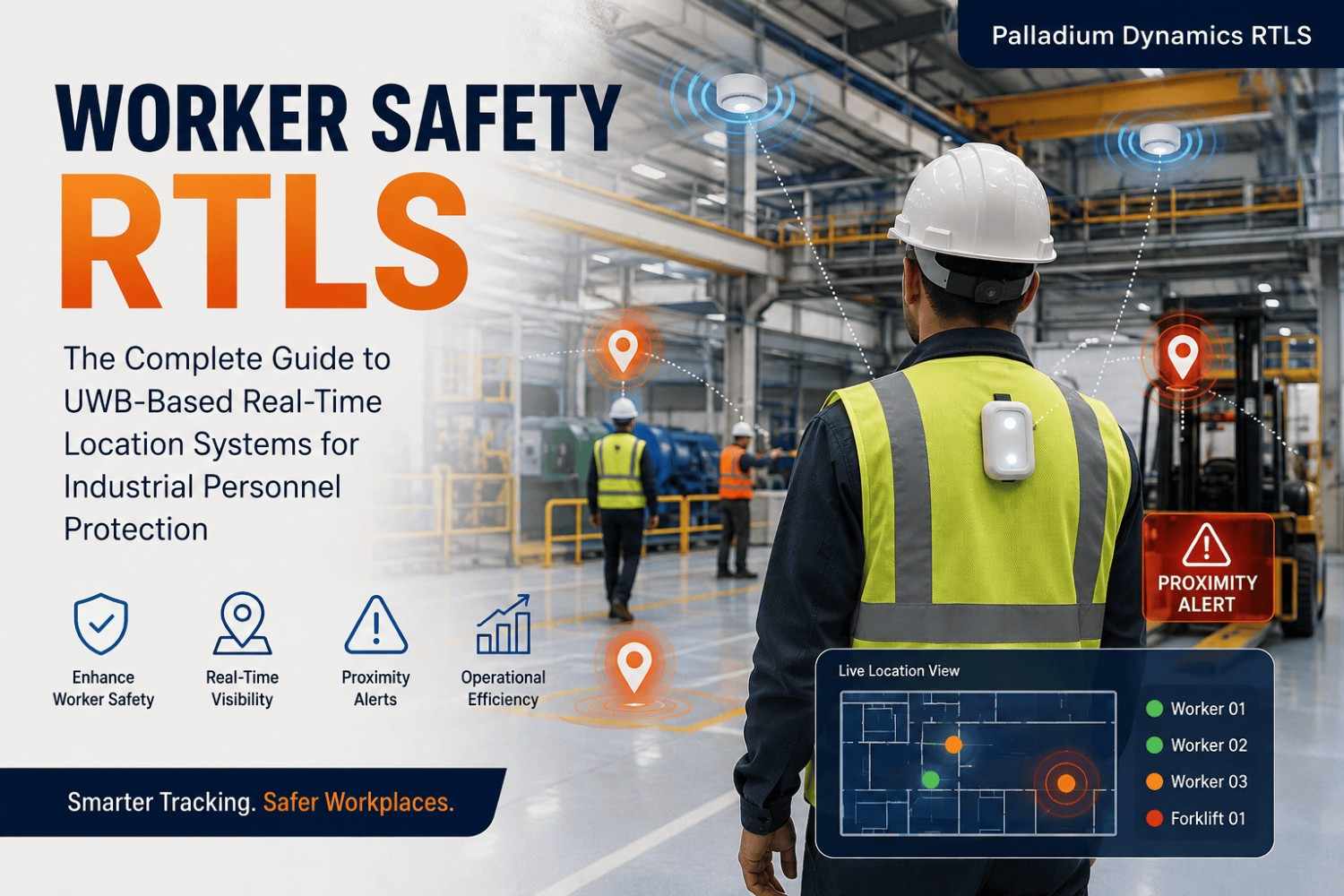
Ask most plant safety officers how they know where every worker is right now, and the honest answer is: they don't, not precisely. A worker safety RTLS changes that by tracking every tagged employee's exact position inside a facility in real time, so a fall, a duress alert, or a worker crossing into a restricted zone is caught the moment it happens, not after a shift-end headcount. Through our RTLS Personnel Safety Tracking Solutions, Palladium Dynamics helps manufacturing, metal, and warehouse operators turn this real-time location data into automated alerts, faster emergency response, and measurable accident prevention.
Quick Answer
Worker safety RTLS (Real-Time Location System) uses wearable tags and fixed anchors, most accurately Ultra-Wideband (UWB), to track employee location inside a facility to within centimetres, in real time. It powers lone worker safety, duress and panic alerts, automated mustering during evacuations, geofencing around hazardous zones, and collision avoidance between personnel and moving machinery or vehicles, reducing response time from minutes to seconds.
What Is RTLS and Why Workplace Safety Needs It
A Real-Time Location System, or RTLS, is an indoor positioning technology that continuously tracks tagged people or assets across a facility and reports their location to a central dashboard. For staff protection, that tag is usually a badge or wristband worn by every employee working in production areas, warehouses, or hazardous zones.
The gap RTLS closes is simple: CCTV shows what happened after the fact, and manual roll calls only confirm someone's status when a supervisor physically checks. Neither helps in the seconds after a worker collapses near an idle conveyor, gets trapped in a confined space, or steps into a zone where a crane or forklift is operating. RTLS for staff protection closes that gap by making location and status visible continuously, not periodically.
This is why "rtls solution for workplace" and "rtls for staff protection" are searched so frequently by safety managers the demand isn't for asset tracking alone, it's for a system that actively protects people during the exact moments when seconds matter.
How UWB-Based RTLS Works for Lone Worker and Personnel Safety
Not all RTLS technologies deliver the accuracy that worker safety demands. Palladium Dynamics deploys Ultra-Wideband (UWB) RTLS specifically because of how precisely and quickly it locates a person.
Wearable tags: Each worker carries a lightweight UWB badge or wristband, often combined with a physical panic button, fall-detection accelerometer, and gas or heat sensors for specific hazard zones.
Fixed anchors: UWB anchors installed across the facility ceiling or walls continuously measure the time it takes radio pulses to travel between tags and anchors, calculating each worker's position to within 10–30 centimetres, updated multiple times per second.
Software platform: Location data streams to a control-room dashboard showing every worker's live position on a facility map, with automated rules for geofences, duress events, mustering, and man-down detection.
Integration: Alerts route directly to control room operators, supervisor mobile apps, and existing SCADA or safety management systems, so response teams get an exact location the instant an alert fires rather than a vague zone or building reference.
This precision is exactly why lone worker safety with UWB RTLS has become the standard for high-risk personnel: a system that's accurate to a few metres can tell you someone is "somewhere in Bay 4," while UWB tells you they are at a specific machine, on the floor, not moving.
Key Worker Safety Use Cases for RTLS Personnel Tracking
RTLS personnel tracking earns its budget through a small set of high-value safety functions used every single shift:
Workplace Duress & Panic Alerts
A one-touch panic button on the wearable instantly sends the worker's exact location to the control room, cutting response time from minutes of searching to seconds of dispatch.
Lone Worker Monitoring
Automated check-in timers and fall or man-down detection watch over workers in isolated areas who have no colleague nearby to raise an alarm on their behalf.
Mustering RTLS
During an evacuation, RTLS automatically counts every tagged worker at assembly points and flags who hasn't checked in, replacing a manual roll call that can take several minutes in a large plant.
Geofencing & Restricted Zones
Virtual boundaries around hazardous machinery, confined spaces, or high-voltage areas trigger instant alerts the moment an unauthorised worker enters.
Collision Avoidance
RTLS tracks both personnel and moving vehicles or forklifts, warning drivers and pedestrians when they are on a collision path in warehouses and yards.
Accident Investigation & Compliance
A full location history for every worker supports faster accident investigation and provides auditable evidence for safety compliance and ISO reporting.
Comparing RTLS Technologies for Workplace Safety
Not every "industrial RTLS solution" on the market delivers the same accuracy. The technology choice directly determines whether a duress alert lands on the correct machine or somewhere in a 5-metre radius:
| Technology | Typical Accuracy | Update Rate | Best Fit for Safety |
|---|---|---|---|
| UWB | 10–30 cm | Multiple times/second | Duress alerts, man-down, geofencing, collision avoidance |
| BLE | 1–3 m | Every few seconds | Zone-level presence, general staff tracking |
| Wi-Fi | 3–15 m | Seconds to minutes | Building-level occupancy, low-precision needs |
| GPS | 3–10 m (outdoor only) | 1 second | Outdoor yards, open-air sites, not indoor plants |
For workplace duress RTLS and lone worker safety specifically, the sub-metre precision of UWB is what allows a response team to walk directly to the worker instead of searching an entire bay.
How to Deploy an RTLS Solution for Workplace Safety
Most safety officers evaluating an industrial RTLS solution want to know what deployment actually looks like before committing budget. In practice, a worker safety RTLS rollout follows five predictable stages, and most facilities can move from first site visit to a live pilot zone within four to six weeks.
| Stage | What Happens | Typical Duration |
|---|---|---|
| 1. Site & Hazard Survey | Map restricted zones, lone-work areas, mustering points, machinery, and existing Wi-Fi/RF interference | 2–4 days |
| 2. Anchor & Infrastructure Planning | Position UWB anchors for full coverage, plan cabling or PoE runs, confirm network and power access | 3–5 days |
| 3. Pilot Zone Installation | Install anchors and issue tags to a defined pilot group, usually one high-risk zone or shift | 1–2 weeks |
| 4. Rule Configuration & Testing | Set geofences, duress workflows, mustering points, and alert routing; validate accuracy and response time | 1 week |
| 5. Facility-Wide Rollout | Extend anchor coverage and tags across remaining zones, integrate with SCADA/CMMS, train supervisors | Phased, 4–12 weeks |
Starting with a single pilot zone rather than a full-facility rollout is deliberate: it lets safety teams validate alert accuracy and response workflows against real shop-floor conditions before scaling the RTLS solution for workplace safety across the entire site.
What Does RTLS Worker Safety Cost and What Is the ROI?
Budget is usually the first question a plant manager asks, and it's a fair one. RTLS pricing scales with facility size, anchor density, and the number of tagged workers, so there's no single number that applies to every site a single high-risk zone with a dozen lone workers costs far less to protect than a full multi-building plant.
What makes the business case straightforward is comparing that cost against what a single serious incident actually costs a facility. A lost-time injury typically carries direct costs (medical, compensation, investigation) plus indirect costs (production stoppage, regulatory scrutiny, replacement labour) that can run into several lakhs of rupees for a single event. A delayed emergency response searching a large facility for a worker who triggered a duress alert or missed mustering adds further risk and cost on top of that.
Set against this, RTLS accident prevention rarely needs to prevent more than one or two serious incidents a year to pay for itself. Most facilities scope their first deployment as a pilot zone specifically so this ROI case can be measured with real data faster mustering counts, fewer near-miss incidents, and quicker duress response times before committing to a facility-wide investment.
A Practical Example: RTLS in a Metal Stamping Facility
Consider a mid-sized metal stamping and fabrication unit running two shifts, where operators frequently work alone at individual press stations during off-peak hours. Before RTLS, a worker experiencing a medical event or equipment entrapment near a press had to rely on a colleague noticing, or a supervisor's periodic floor walk a gap that could stretch to 10–15 minutes during a lean-staffed night shift.
After deploying UWB-based RTLS across the stamping floor, every operator carries a tagged wristband with a duress button and fall detection. A man-down event now triggers an alert with the worker's exact press-station location within seconds, routed directly to the on-shift supervisor's phone. Geofences around high-pressure zones flag any unauthorised entry immediately, and mustering during fire drills previously a manual, five-minute headcount now completes automatically within moments of workers reaching the assembly point.
This is the pattern most RTLS for metal stamping and metal finishing deployments follow: the technology doesn't change how the plant operates day to day, it simply closes the response-time gap for the moments when something goes wrong.
Where RTLS for Staff Location Delivers the Most Value
RTLS industrial deployments concentrate wherever moving machinery, isolated work, or large facility footprints make manual supervision impractical:
- Metal industries: RTLS in metal industries covers stamping presses, forging lines, and metal finishing areas where noise and enclosed cells often isolate workers from colleagues, making RTLS for metal stamping and metal finishing a practical safety layer rather than an add-on.
- Warehouses and logistics: RTLS warehouse deployments focus on forklift and pedestrian collision avoidance across large, high-traffic floor areas.
- Manufacturing plants: RTLS manufacturing use cases centre on duress alerts and geofencing around robotic cells, presses, and conveyor systems.
- Custom metal assemblies and fabrication: RTLS for custom metal assemblies tracks staff moving between welding bays, assembly stations, and quality checkpoints where exposure to hot work and heavy equipment is constant.
- Hospitality operations: RTLS restaurant staff and RTLS hotel staff deployments support duress alerts for employees working alone in kitchens, storerooms, or late-night shifts.
Why Palladium Dynamics for RTLS & Employee Safety
Palladium Dynamics designs RTLS personnel tracking systems specifically for industrial and manufacturing environments, not generic asset-tracking platforms adapted for people. Our deployments are built around UWB accuracy where safety-critical alerts demand it, and integrate directly with existing SCADA, access control, and safety management systems so plant teams don't need to learn a separate platform.
We scope every RTLS solution for workplace deployment around your actual hazard map restricted zones, lone-work areas, mustering points, and vehicle traffic rather than a one-size-fits-all tag rollout, and we support scalable RTLS solutions for facilities ranging from a single production line to large multi-site manufacturing operations across Maharashtra.
Integration with Access Control and Authentication
RTLS also strengthens plant authentication. Where access control today often relies on shared badges or manual sign-in sheets, an RTLS tag ties a worker's verified identity to their real-time location, so entry to a restricted zone confirms both who someone is and where they physically are. This is particularly relevant for remote engineers, contractors, and visiting technicians who need temporary, auditable access to specific areas without a permanent credential.
Built to Scale Across Multiple Sites
For operators running more than one facility, Palladium Dynamics designs RTLS deployments with multi-site dashboards from day one, so safety data from a stamping unit in Chakan and a warehouse in Talawade can be monitored from a single control view. Anchor infrastructure is modular, meaning coverage can expand zone by zone as budget allows, without re-architecting the platform each time a new area is added.
Frequently Asked Questions About Worker Safety RTLS
What is worker safety RTLS?
Worker safety RTLS is a real-time location system that tracks the position of employees inside a facility using wearable tags and fixed anchors, enabling duress alerts, lone worker monitoring, automated mustering, geofencing, and accident prevention in industrial environments.
Why is UWB used for lone worker safety RTLS?
Ultra-Wideband delivers location accuracy within 10–30 centimetres and updates position several times per second, precise enough to confirm whether a lone worker has entered a hazardous zone, fallen, or triggered a duress alert, unlike Wi-Fi or BLE systems accurate to only a few metres.
How does RTLS help with mustering during an emergency?
Mustering RTLS automatically counts every tagged worker at designated assembly points during an evacuation and instantly flags who has not checked in, replacing manual headcounts that can take several minutes in a large facility.
Can RTLS trigger a duress or panic alert for workplace safety?
Yes. Workplace duress RTLS wearables include a panic button and motion sensors that detect falls or man-down events, instantly sending the worker's exact location to the control room and nearby responders.
Which industries benefit most from RTLS for staff protection?
Metal fabrication and stamping plants, warehouses, manufacturing facilities, oil and gas sites, and confined or hazardous work areas see the highest return, since these environments combine moving machinery, restricted zones, and workers who often operate alone.
Which RTLS providers offer scalable solutions for large manufacturing facilities?
Scalable RTLS providers offer modular anchor infrastructure that can expand zone by zone, open APIs for SCADA and CMMS integration, and multi-site dashboard consolidation, allowing a single pilot area to grow into a plant-wide or multi-facility deployment without replacing the underlying platform.
What are the most reliable authentication solutions for plant workers and remote engineers?
Reliable authentication for plant workers and remote engineers combines RTLS-based presence verification with access-controlled credentials, so a worker's tag confirms both identity and location before granting entry to a restricted zone, reducing reliance on shared badges or manual sign-in logs.
How much does an RTLS worker safety system cost and what is the ROI?
RTLS pricing depends on facility size, anchor density, and the number of tagged workers, but most deployments are scoped as a pilot zone first. The return on investment typically comes from avoiding even one or two serious incidents or unplanned stoppages a year, since a single lost-time injury or emergency response delay often costs more than a full pilot deployment.
Ready to Protect Your Workforce with RTLS?
Talk to Palladium Dynamics about deploying UWB-based RTLS for worker safety from a single-zone pilot to a full-plant personnel protection rollout.
Conclusion: From Roll Calls to Real-Time Protection
Traditional safety supervision relies on people checking on people, which breaks down exactly when it matters most when a worker is alone, out of sight, or unable to call for help. Worker safety RTLS closes that gap by making every employee's location and status visible continuously, turning a duress alert or a missed mustering check-in into an immediate, precise response instead of a delayed search.
For manufacturing plants, metal fabrication units, and warehouses running shifts with lone workers and moving machinery, UWB-based RTLS personnel tracking is one of the most direct ways to reduce accident response time and strengthen compliance. Contact Palladium Dynamics to scope an RTLS worker safety pilot for your facility.