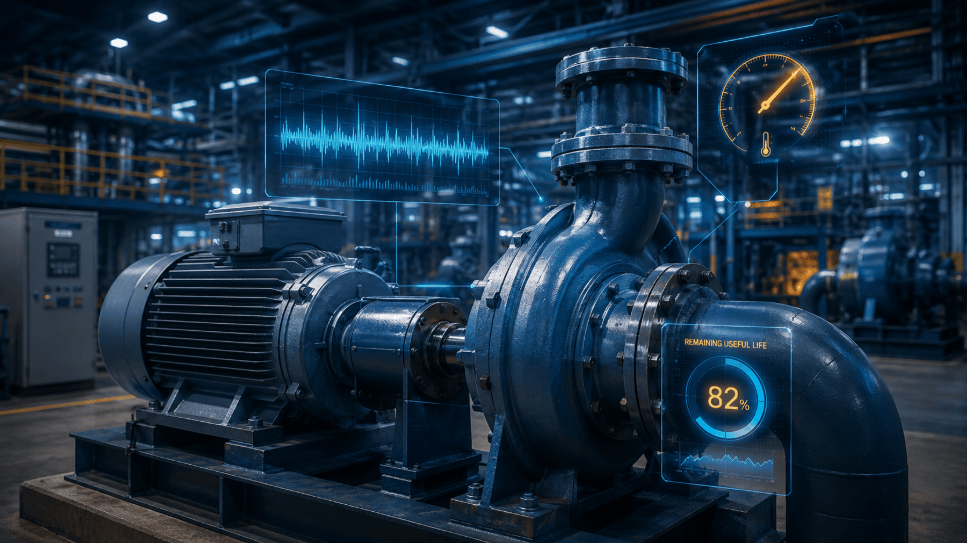
In most industrial plants, the first sign of a failing pump or motor bearing is the moment it actually fails usually mid-shift, always inconveniently. AI-based Remaining Useful Life (RUL) prediction removes that uncertainty by continuously analyzing vibration, temperature, and electrical signature data from rotating equipment to forecast, in days or weeks, exactly when an asset will need attention. Through our Industrial AI Solutions, Palladium Dynamics turns this forecast into a practical maintenance schedule, not just an alert.
Quick Answer
Remaining Useful Life (RUL) prediction uses AI models trained on vibration, temperature, motor current, and acoustic sensor data to estimate how many operating hours or days remain before a pump, motor, or rotating component is likely to fail. Rather than relying on fixed maintenance calendars or waiting for breakdowns, RUL prediction tells maintenance teams which specific asset needs attention and when reducing unplanned downtime while avoiding unnecessary part replacement.
What Is RUL Prediction and Why Rotating Equipment Needs It
Pumps, motors, fans, and compressors fail in predictable ways bearing wear, misalignment, winding insulation breakdown, cavitation, and lubrication failure all leave measurable signatures in vibration and thermal data long before a breakdown occurs. The challenge has never been a lack of warning signs; it's that most maintenance teams aren't continuously watching for them.
Traditional maintenance takes one of two approaches, both imperfect. Reactive maintenance repairs equipment only after it fails, guaranteeing unplanned downtime. Preventive maintenance services equipment on a fixed calendar or runtime schedule regardless of actual condition which means healthy components get replaced too early, while assets under unusual stress can still fail between scheduled checks.
RUL prediction replaces both with a condition-based approach: it tracks each asset's actual health trajectory and tells you, in real terms, how much useful life remains so maintenance happens exactly when it's needed, not before and not after.
How AI-Based RUL Prediction Works
Palladium Dynamics' RUL prediction systems combine industrial sensors with machine learning models trained specifically on rotating-equipment degradation patterns.
Sensing layer: Vibration accelerometers, temperature sensors, and motor current signature analysis (MCSA) clamps are installed on pumps, motors, and rotating assets either retrofitted to existing equipment or integrated during new installations. Acoustic emission and oil analysis sensors are added where relevant.
Data pipeline: Sensor data streams continuously through edge gateways to an AI platform, either cloud-hosted or on-premises depending on connectivity and data-governance requirements.
Prediction models: Time-series degradation models including LSTM neural networks and physics-informed machine learning analyze how vibration signatures, thermal patterns, and current draw shift over time relative to each asset's healthy baseline. The output is a continuously updated RUL estimate in operating hours or days, along with a confidence band and early-warning thresholds.
Integration: RUL estimates and alerts feed directly into existing SCADA, CMMS, or maintenance dashboards, so plant teams act on the prediction without learning a new system.
How RUL Prediction Reduces Unplanned Downtime and Maintenance Costs
The financial case for RUL prediction comes down to one number most plants already track: the cost of an hour of unplanned downtime. Consider a mid-sized process plant running critical pumps and motors continuously a single unplanned motor failure can halt an entire line for hours, combining lost production, emergency labor at premium rates, and expedited spare-parts freight. Multiply that by even three or four unplanned stoppages a year, and the cost easily runs into several lakhs of rupees in lost output alone, before counting repair costs.
RUL prediction attacks this cost from two directions simultaneously. It eliminates most unplanned stoppages by flagging developing faults weeks ahead of failure, giving teams time to schedule a controlled shutdown, order parts in advance, and avoid premium emergency pricing. At the same time, it eliminates over-maintenance bearings, seals, and windings are replaced only when actual condition data shows it's necessary, not on an arbitrary calendar that often wastes good remaining life.
The result is a maintenance budget that shrinks on both ends: fewer emergencies, and less unnecessary part replacement. For rotating equipment running 16–24 hours a day, that combination typically pays for the RUL prediction system within the first one or two prevented failures.
Comparing Maintenance Approaches
The difference between reactive, preventive, and RUL-based predictive maintenance becomes clear when compared side by side:
| Approach | Basis for Action | Downtime Risk | Cost Impact |
|---|---|---|---|
| Reactive Maintenance | Repair after failure | High — always unplanned | Highest (emergency labor, lost production) |
| Preventive Maintenance | Fixed calendar / runtime schedule | Moderate — gaps between checks | High (premature part replacement) |
| RUL Prediction | Real-time AI condition forecast | Low — scheduled around actual need | Lowest (right-time intervention) |
Where RUL Prediction Applies: Pumps, Motors & Rotating Equipment
RUL prediction delivers value anywhere rotating equipment runs continuously and unplanned downtime is expensive or unsafe:
- Water and wastewater infrastructure: Pumping station motors and pumps running 24/7, where a single failure can disrupt service to an entire facility or region.
- Manufacturing plants: Conveyor motors, compressors, and process pumps on production lines where any stoppage halts output across the entire line.
- Oil, gas & process industries: Rotating equipment including compressors, turbines, and large process pumps, where failures carry both production and safety consequences.
- Utilities and HVAC: Chillers, cooling tower motors, and air-handling equipment supporting continuous facility operations.
Across all these applications, the underlying physics of rotating-equipment failure — bearing wear, imbalance, misalignment, insulation breakdown — is consistent, which is why a well-trained RUL model adapts efficiently from one asset class to another.
Why Palladium Dynamics for RUL Prediction
Palladium Dynamics builds AI-powered industrial intelligence platforms specifically for manufacturing and infrastructure operators — not generic IoT dashboards repurposed for maintenance. Our RUL prediction systems are sensor-agnostic, integrate with the SCADA, CMMS, and asset management systems plants already use, and are engineered for the connectivity and data-governance constraints common in Indian industrial environments.
Our team has applied AI-driven predictive maintenance modeling to critical rotating assets including pumping station equipment, where the cost of unplanned downtime extends beyond production into service continuity. We design every deployment around your actual failure modes and operating data, not a one-size-fits-all model.
Frequently Asked Questions About RUL Prediction
What is Remaining Useful Life (RUL) prediction?
RUL prediction is an AI-based predictive maintenance technique that estimates how many operating hours or days remain before a pump, motor, or rotating component is likely to fail, using continuous analysis of vibration, temperature, current, and acoustic sensor data.
How accurate is AI-based RUL prediction for pumps and motors?
Accuracy depends on sensor quality, historical failure data, and asset type, but well-tuned RUL models for rotating equipment typically narrow failure windows to within days rather than the multi-week uncertainty of calendar-based maintenance, and improve further as more operating data is collected.
What sensors are needed for RUL prediction on rotating equipment?
Most RUL prediction systems use vibration accelerometers, temperature sensors, and motor current signature analysis (MCSA) clamps, with acoustic emission or oil analysis sensors added where relevant.
How is RUL prediction different from preventive maintenance?
Preventive maintenance follows a fixed calendar or runtime schedule regardless of actual asset condition, while RUL prediction uses real-time sensor data to forecast failure for each specific asset, avoiding both premature part replacement and unexpected breakdowns.
How long does it take to deploy an RUL prediction system?
A typical pilot deployment for a group of pumps or motors takes 4 to 8 weeks, covering sensor installation, baseline data collection, AI model training, and dashboard integration with existing SCADA or CMMS systems.
Ready to Reduce Unplanned Downtime on Your Pumps & Motors?
Talk to Palladium Dynamics about deploying AI-based RUL prediction across your critical rotating equipment — from pilot installation to full-plant rollout.
Conclusion: From Guessing to Knowing
Unplanned downtime on a pump or motor is rarely a surprise to the equipment itself — the warning signs exist in vibration, heat, and current data well before failure. AI-based RUL prediction simply makes those signs visible to your maintenance team in time to act.
For plants and infrastructure operators running rotating equipment around the clock, shifting from calendar-based or reactive maintenance to RUL prediction is one of the highest-return automation investments available today. Contact Palladium Dynamics to scope an RUL prediction pilot for your pumps, motors, or rotating equipment.